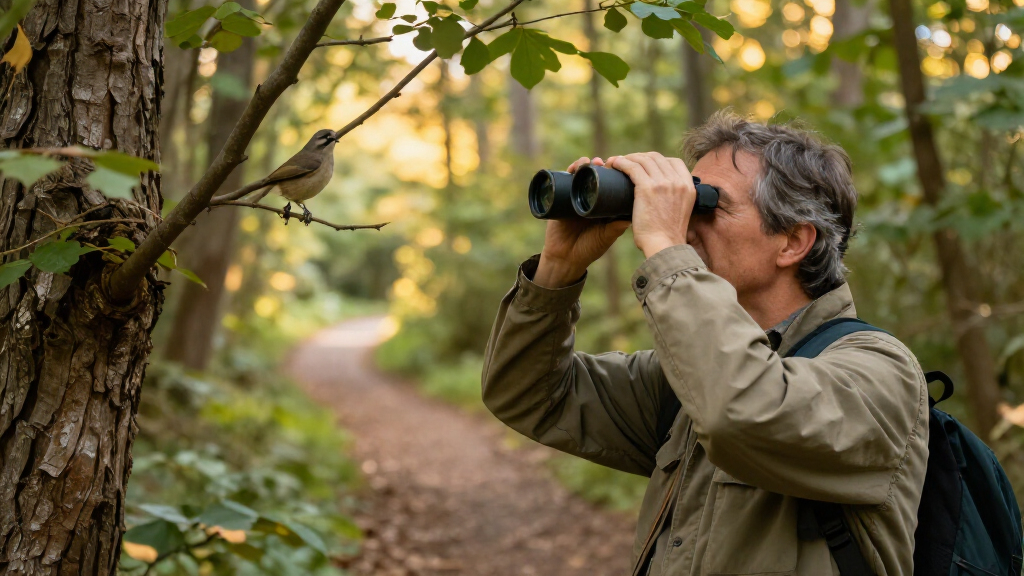

TL;DR

Get health and wellness essentials delivered free with Prime
- Fast, free delivery on millions of items
- Prime Video, Amazon Music and more included
- Member-only deals all year
A study led by Erik Wing found differences in brain activity and organisation between expert birdwatchers and novices. The research does not establish that birdwatching caused those differences or slows cognitive decline, while separate studies suggest birdwatching may support wellbeing among care-home residents.
Research on birdwatchers has found that experts show different brain activity and organisation from novices in regions involved in attention and visual recognition, a finding that may help explain how learning the skill affects the brain. The study does not prove birdwatching slows cognitive decline, but it adds to evidence being explored alongside birdwatching programmes for older people and people with dementia.
Neuroscientist Erik Wing of Baycrest Academy for Research and Education in Toronto and colleagues compared MRI scans of expert birdwatchers and novices as they identified birds. The experts showed more activity in brain regions involved in attention, visual perception and visual recognition, particularly when identifying unfamiliar birds. Some of these regions also showed higher organisation and coherence among experts than among novices of similar age.
Wing told BBC Future that the results could reflect neuroplasticity—the brain’s ability to change over time—but the study cannot determine whether birdwatching caused the differences or whether people with those brain characteristics are more likely to become experts. The report also says the findings do not establish that the observed brain patterns translate into broader protection against cognitive decline.
Other research described in the report addresses birdwatching as a social and wellbeing activity, rather than expertise. A study of 388 birdwatchers in Poland found that people who considered birding important and were enthusiastic about it reported more psychological restoration than skilled but less enthusiastic participants. In a separate project, researchers placed bird feeders at 65 nursing homes and reported improvements in residents’ wellbeing and cognition after a few weeks. The report does not provide numerical effect sizes for those changes.
What Brain Differences May Mean
The research offers a reason to investigate whether sustained bird identification exercises mental skills used for attention and visual recognition. Those abilities matter in daily life, and the finding that some brain regions were more organised among experts of similar ages has prompted interest in whether an acquired skill could help preserve aspects of brain function.
But the distinction between a promising association and a proven intervention matters for readers. The scan results do not show that taking up birdwatching prevents dementia, slows an individual’s decline, or replaces clinical care. The care-home findings instead suggest birdwatching may provide social contact, enjoyment and engagement, which can matter to residents even if its effect on long-term cognition remains unknown.
For families and care providers, the practical implication supported by the report is modest: accessible opportunities to notice birds, including from a window or shared indoor space, may be enjoyable and may support wellbeing. The evidence presented is not a guarantee of cognitive benefit.
Products Worth Considering

Cuisinart 6-Quart Basket Air Fryer with Viewing Window, Stainless Steel and Black (AIR-200NAS)

Le Creuset Signature 6.5-Quart Deep Round Dutch Oven with Light Gold Crucible Knob, Enameled Cast Iron, Bleu Riviera

Instant Pot Vortex Plus 10-Quart 7-in-1 Air Fryer Oven
As an affiliate, we earn on qualifying purchases.
Birdwatching in Care Settings
The BBC report describes a weekly birdwatching group at Forge Mill Lake in the West Midlands, run by the charity Age UK. One participant, identified by the report as 78-year-old Harold, had become withdrawn and anxious after developing dementia. His daughter brought him to the group; she later saw him smile and laugh while watching birds. The account illustrates an individual experience, not evidence that birding changes dementia progression.
Age UK community dementia adviser Jenny Budinger said the group gave Harold a moment when he was present rather than worried about memory or confidence. The report says birdwatching groups have also been established in care settings in the UK, Germany and the United States. Kals’s nursing-home project took a low-barrier approach, letting residents watch local birds from a common area rather than requiring outdoor trips or specialist identification skills.
““a kind of preservation of organisation””
— Erik Wing, neuroscientist at Baycrest Academy for Research and Education, as quoted by BBC Future
Limits of the Brain Evidence
The brain-imaging comparison cannot show whether birdwatching produced the differences or whether the experts already differed before becoming skilled. The report also says more research is needed to understand what the observed preservation of brain organisation means and whether it relates to wider cognitive function.
It remains unclear whether people who begin birdwatching later in life would show similar brain changes, how much activity would be needed, or whether any effect could alter the course of dementia. The reported care-home and Polish findings concern wellbeing and self-reported restoration as well as cognition; the report does not give enough detail to establish the size, durability or cause of those outcomes.
Research Needed on Long-Term Effects
The next research step is to test whether birdwatching itself leads to changes over time, rather than simply comparing people who are already experts with novices. Studies would also need to assess whether brain measures correspond to meaningful changes in memory or other everyday abilities, and whether benefits apply to beginners and older adults who take up the activity later.
For care settings, the report’s findings support further evaluation of accessible birdwatching programmes, including whether reported gains in wellbeing and cognition persist beyond the first weeks. Until stronger evidence is available, birdwatching can be described as a potentially engaging activity—not a proven way to prevent or treat cognitive decline.
Key Questions
Does this study prove birdwatching slows cognitive decline?
No. It found brain differences between expert birdwatchers and novices, but it did not establish that birdwatching caused them or slowed cognitive decline.
What brain differences did researchers report?
Experts showed more activity in some regions involved in attention, visual perception and visual recognition while identifying birds. Some of those regions also had higher organisation and coherence than in novices of similar age.
Do you need to be an expert birder to benefit?
The report describes wellbeing findings suggesting enthusiasm may matter more than skill for psychological restoration. It does not establish that birdwatching benefits everyone or prevents cognitive decline.
What did the nursing-home project find?
Researchers installed bird feeders outside 65 nursing homes. The BBC report says residents’ wellbeing and cognition improved after a few weeks, but gives no numerical effect size and does not establish that birdwatching caused lasting changes.
Source: hn