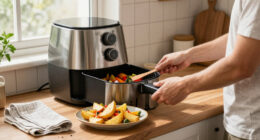
Choosing an air fryer for healthy cooking is less about finding a machine that makes food automatically healthy and more about choosing a format you will use for balanced meals. Basket-style air fryers focus on a compact cooking chamber and a removable drawer; oven-style models offer racks and often support several cooking modes. Either can brown food with little added oil compared with deep frying, but ingredients, portions, and cooking habits still determine the meal’s overall nutrition.

Get health and wellness essentials delivered free with Prime
- Fast, free delivery on millions of items
- Prime Video, Amazon Music and more included
- Member-only deals all year

Cuisinart Air Fryer, Glass Basket & ClearView Window, 5 Functions, 4 Qt
- ✔ Capacity: 4 quarts
- ✔ Cooking functions: Air fry, bake, broil, recrisp, keep warm
- ✔ Maximum temperature: 450°F, adjustable in 5-degree increments

Chefman 4.5 Qt Air Fryer with Dual Control Temperature, Nonstick Stainless Steel, Dishwasher Safe Basket, 60-Minute Timer & Auto…
- ✔ Capacity: 4.5 quarts
- ✔ Maximum temperature: 400°F
- ✔ Minimum temperature: 100°F

Dash Compact Air Fryer – 2 Qt, Cool Grey
- ✔ Capacity: 2 quarts (1.2 liters)
- ✔ Temperature range: 85°C–200°C
- ✔ Wattage: 1650 watts
The practical decision is between speed and simplicity on one side, and capacity and flexibility on the other. A basket model usually suits one or two people cooking vegetables, fish, or modest portions. An oven model is a stronger fit for families, batch cooking, or anyone who wants one appliance to roast, toast, and air fry. The comparison below focuses on the features that affect everyday healthy cooking, not on a promise that either format improves every recipe.
At a Glance
| Criteria | Basket-style air fryer | Oven-style air fryer | Winner |
|---|---|---|---|
| Added-oil cooking | Typically browns foods with a light coating or no added oil, depending on the recipe. | Also supports low-oil cooking; results depend on food, airflow, and how fully the racks are loaded. | Tie |
| Small-batch speed | Usually quick to preheat and cook a small portion; the drawer concentrates airflow around the food. | Can take longer for a small portion, especially if the larger cavity needs preheating. | A |
| Capacity and batch cooking | Best for a few servings; larger batches may need to be cooked in rounds. | Multiple racks and a larger cavity make it better for family portions and batch cooking. | B |
| Cooking flexibility | Strong for air-fried staples, but less suited to tasks such as toast or multi-rack cooking. | Often adds toast, roasting, baking, or other modes, depending on the model. | B |
| Ease of cleanup | A removable basket and drawer are straightforward to empty and wash, though food can stick to the basket. | More racks, trays, and interior surfaces can mean more parts to clean. | A |
| Counter space | Compact footprint suits smaller kitchens, with drawer clearance needed for use. | Takes more counter space and needs room for door access and ventilation. | A |
| Value for healthy cooking | Often the lower-cost route if air frying is the main goal. | Higher cost can make sense if the extra capacity and modes replace other appliances. | Depends |
Cuisinart Air Fryer, Glass Basket & ClearView Window, 5 Functions, 4 Qt
The Cuisinart ClearView earns our top spot because it combines a useful mid-size basket with the broadest cooking range here. Its 4-quart capacity is more accommodating than Dash’s 2-quart basket for shared meals, while the 450°F maximum exceeds Chefman’s 400°F ceiling. That temperature headroom and five functions—air fry, bake, broil, recrisp, and keep warm—make it a better fit for cooks who want one appliance to cover more than crisping frozen food.Visibility is its defining advantage. The glass basket, top window, and interior light let us check browning without pulling the basket open, which can be handy when a recipe needs close monitoring. The glass basket and crisper plate are dishwasher safe, and the included lid allows leftovers to be stored in the basket. These features make the design appealing for cooks who want to keep an eye on food and reduce cleanup steps.There are meaningful compromises. Glass is heavier and more vulnerable to damage than a conventional metal basket, so this is less convenient to move or handle casually. The package also includes only one basket, limiting our ability to prepare separate foods at once. Compared with Chefman, it gives up half a quart of stated capacity; compared with Dash, it takes a larger commitment to storage and handling. We rank it first because its visibility and cooking range make it the most adaptable choice for a broad set of lower-oil meals.
Pros:
- Glass basket and illuminated viewing window make it easier to check food as it cooks.
- Five cooking functions offer more flexibility than the simpler Dash and Chefman setups.
- 450°F maximum temperature gives more headroom than Chefman’s 400°F limit.
- Dishwasher-safe basket and crisper plate simplify cleanup, and the lid supports leftover storage.
Cons:
- Glass can be heavier and more fragile than a metal basket.
- Only one basket is included, so different foods cannot be separated into simultaneous cooking zones.
- Its 4-quart capacity is smaller than Chefman’s listed 4.5-quart capacity.
Best for: Cooks who want a versatile, mid-size air fryer with a visible glass basket, dishwasher-safe parts, and extra temperature range.
Not ideal for: Anyone who wants the lightest, most durable-feeling basket or needs separate compartments for cooking multiple foods at once.
Bottom line: We recommend the Cuisinart for the best balance of cooking flexibility, visibility, and everyday capacity, provided its glass construction suits your handling preferences.
“We recommend the Cuisinart for the best balance of cooking flexibility, visibility, and everyday capacity, provided its glass construction suits your handling preferences.”
Chefman 4.5 Qt Air Fryer with Dual Control Temperature, Nonstick Stainless Steel, Dishwasher Safe Basket, 60-Minute Timer & Auto…
Chefman is the capacity choice in this comparison, with a 4.5-quart basket that edges past Cuisinart’s 4 quarts and is more suitable than Dash for cooking substantial portions. That extra room can help when we want to prepare a shared side or make more food in one batch. Its stated design also aims to keep a compact footprint, which may appeal to kitchens where counter space is at a premium but a 2-quart appliance would be too limiting.The controls favor straightforward cooking: the model includes four presets, a 60-minute timer, and auto shutoff. The basket is dishwasher safe, so cleanup is relatively simple for a larger-capacity pick. Chefman’s description claims cooking with up to 98% less oil, but we should treat that as an “up to” claim rather than a promise for every ingredient or recipe. Like the other options here, actual added oil depends on what we cook and how we prepare it.Its 400°F maximum is the main limitation beside Cuisinart’s 450°F ceiling, and the supplied description notes that the single knob arrangement limits fine adjustments. It also lacks a digital touchscreen. For buyers who value a bigger basket and uncomplicated presets, those compromises may be acceptable; cooks who need a wider temperature range and more granular settings should favor Cuisinart. Chefman ranks second because it expands portions without matching the top pick’s cooking flexibility.
Pros:
- The 4.5-quart basket has the largest stated capacity among these three models.
- Four presets, a timer, and auto shutoff support straightforward operation.
- Dishwasher-safe nonstick basket helps simplify cleanup.
- Stainless-steel styling offers a different look from Dash’s plastic-bodied compact design.
Cons:
- The 400°F maximum is lower than Cuisinart’s 450°F ceiling.
- The single-knob interface offers less fine control than more adjustable options.
- It does not provide Cuisinart’s glass viewing window or five cooking functions.
Best for: Households that need a larger single-basket capacity and prefer preset-based controls with dishwasher-safe cleanup.
Not ideal for: Cooks who want temperatures above 400°F, fine-grained digital control, or a clear window for checking food.
Bottom line: Choose Chefman when basket capacity matters more than high-heat range or detailed control.
“Choose Chefman when basket capacity matters more than high-heat range or detailed control.”
Dash Compact Air Fryer – 2 Qt, Cool Grey
Dash serves a different buyer than the two larger models: it is built for a small footprint and small portions. Its 2-quart capacity is half the Cuisinart’s and less than half Chefman’s listed 4.5 quarts, so it is best suited to one-person meals or a limited side dish. For a dorm, RV, or crowded counter, that size can make the appliance easier to place and keep available instead of taking up space for capacity we rarely need.The Dash uses AirCrisp technology, adjustable temperature control, and a timer, with auto shutoff and a cool-touch handle listed as safety features. Its description says it can deliver crispy results with up to 75% less added fat. That claim may be relevant to cooks comparing air frying with deep frying, but it does not mean every meal requires no oil or that every result will be the same. The removable nonstick basket also makes routine cleaning more approachable than managing Cuisinart’s heavier glass construction.Where Dash loses ground is versatility by volume. A 2-quart basket can force multiple batches when cooking for more than one or two people, which undercuts its convenience for family meals. Its plastic outer body may also feel less substantial than Chefman’s stainless-steel styling, and its temperature is listed in Celsius while the other models specify Fahrenheit. We place it third overall because its compactness is a strong niche advantage, but it cannot match the larger models for meal flexibility.
Pros:
- Compact 2-quart design suits kitchens and living spaces with limited room.
- Adjustable temperature control and timer allow more choice than a fixed setting.
- Auto shutoff and cool-touch handle add practical safety features.
- Removable nonstick basket is easier to handle than Cuisinart’s glass basket.
Cons:
- The 2-quart capacity is substantially smaller than both other picks.
- Small portions may require multiple batches for shared meals.
- Plastic outer construction may feel less substantial than Chefman’s stainless-steel styling.
Best for: Students, solo cooks, RV users, and anyone who values compact storage over cooking larger portions.
Not ideal for: Families, batch cooks, or anyone who wants one appliance to prepare a full meal for several people.
Bottom line: Dash is the sensible compact pick when we cook for one and storage space matters more than basket capacity.
“Dash is the sensible compact pick when we cook for one and storage space matters more than basket capacity.”
As an Amazon Associate we earn from qualifying purchases.
Key Differences
Both formats can support lower-oil cooking than deep frying because they circulate hot air instead of submerging food in oil. That advantage is most useful for foods that crisp well with a small amount of oil, such as vegetables or homemade potato wedges. It does not make every dish low in calories or salt: breading, sauces, portion size, and the ingredients themselves still matter. Neither format has an inherent nutritional advantage when cooking the same food in similar portions.
The basket model’s edge is focused cooking. Its smaller chamber and single drawer make it convenient for quick meals and modest portions, though a household cooking several servings may need to work in batches. The oven model trades some speed and simplicity for room to spread food across racks and prepare more at once. That helps with family meals and meal prep, but crowded racks can still limit browning, and more accessories create more washing.
For value, pay extra for an oven-style model when its usable capacity and additional cooking modes will replace appliances or make regular batch cooking easier. If air frying is the main task and the household is small, the basket format is generally the more economical and space-conscious choice. Healthy results depend more on the food and cooking routine than on buying the larger or more expensive appliance.
Detailed Comparison
Added-oil cooking (minor difference)
Result: Tie; the difference is minor. Both formats circulate hot air and can brown many foods with little added oil. A light coating may improve texture for vegetables or homemade fries, while naturally fatty foods may need none. Neither appliance guarantees a healthier meal: the recipe, portion, salt, and ingredients matter more than the shape of the cooking chamber.
Small-batch speed (Basket-style air fryer wins — moderate)
Basket-style wins; the difference is moderate. Its compact chamber is well suited to a single portion or a quick side, and many models need little preheating. An oven-style unit may take longer to heat its larger interior, so its extra capacity offers little benefit when cooking only a small amount. For frequent quick lunches or dinners for one or two, this convenience can make home cooking easier to sustain.
Capacity and batch cooking (Oven-style air fryer wins — major)
Oven-style wins; the difference is major for families and meal prep. Racks provide room to cook more food in one session, while a basket often requires successive batches for several people. That can make the oven format more practical for preparing vegetables and a main component together. Its advantage depends on usable rack space and airflow: overloading either style can lead to uneven browning, so capacity claims should be judged by the food you actually cook.
Cooking flexibility (Oven-style air fryer wins — moderate)
Oven-style wins; the difference is moderate. Many oven-style models add functions such as toast, roast, or bake, giving them a broader role in the kitchen. Basket units are more specialized and often do their central job well, but may leave other cooking tasks to a separate appliance. Check the modes on the specific model, since features vary. Pay for this flexibility when you will use it regularly.
Ease of cleanup (Basket-style air fryer wins — moderate)
Basket-style wins; the difference is moderate. A removable drawer and basket are usually simpler to clear and wash than several oven racks and trays. Oven-style models can leave grease or crumbs on more surfaces, especially after cooking across multiple levels. The basket still needs regular cleaning, and nonstick coatings require care. If cleanup affects whether you cook at home, the simpler layout is a meaningful practical advantage.
Counter space (Basket-style air fryer wins — moderate)
Basket-style wins; the difference is moderate. Its compact body is easier to fit in a small kitchen, although the drawer needs space to slide out during use. An oven-style appliance takes up more counter area and needs clear space around its door and vents. Measure the intended location and check the model’s operating instructions before buying; the room required during use can be greater than its stored footprint suggests.
Value for healthy cooking (moderate difference)
Depends on the household; the difference is moderate. Basket-style models usually provide better value when the aim is simply to prepare small portions with little oil. Oven-style models can justify a higher price if their larger capacity and extra modes get regular use or replace appliances already occupying the kitchen. If those features go unused, the added cost and counter space do not improve the nutrition of the same meal.
Basket-style air fryer: Pros and Cons
Pros:
- Quick and convenient for small portions.
- Compact footprint and usually straightforward cleanup.
- Often costs less when air frying is the main need.
- Works well for vegetables, fish, and other modest portions with little added oil.
Cons:
- Small capacity may mean repeated batches for a household.
- Less versatile for toast, multi-rack cooking, or other appliance tasks.
- Cooking several components at once can be awkward.
Oven-style air fryer: Pros and Cons
Pros:
- More room for family portions and batch cooking.
- Multiple racks can help prepare different foods in one session.
- Often includes additional cooking modes such as roasting or toasting.
- Can replace other countertop appliances for households that use those modes.
Cons:
- Larger footprint may not suit a compact kitchen.
- More trays and racks can make cleanup take longer.
- May be less efficient for a single small serving.
- Typically costs more, and extra features have little value if unused.
Who Should Choose What
Choose Basket-style air fryer if:
- You usually cook for one or two people and want quick meals or sides.
- You have limited counter space and prefer a simple drawer to clean.
- Air frying is your main goal and you do not need extra cooking modes.
Choose Oven-style air fryer if:
- You regularly cook for a family or prepare food in batches.
- You want room to spread ingredients across racks and cook more at once.
- You will use the additional modes and value consolidating countertop appliances.
Skip both if: Skip both if you rarely cook foods that benefit from circulating hot air, have no suitable counter space, or expect an appliance alone to make highly processed or oversized portions healthy.
Value for Money
A higher price for an oven-style air fryer is worth paying when its capacity solves a real problem: repeated batches, family meals, or routine use of its extra cooking modes. Those benefits can save time and make the appliance useful beyond air frying. For a smaller household that mainly wants crisp vegetables or an occasional side with little oil, a basket-style model is typically better value. The more expensive format does not produce a healthier result by default; pay for the space and functions you will use.
Final Verdict
For most people buying an air fryer specifically for healthier everyday cooking, choose a basket-style model if you cook small portions and want speed, easy cleanup, and lower cost. Choose an oven-style model if you regularly feed a family, batch cook, or will use its other cooking modes. The biggest deciding factor is how much food you cook at once: the basket wins on convenience for small meals, while the oven wins on capacity and flexibility. Either can help reduce reliance on deep frying, but ingredients and portions remain the deciding factors in how healthy the meal is.
Frequently Asked Questions
Which air fryer is healthier, basket-style or oven-style?
Neither format is inherently healthier. Both can cook many foods with little added oil. Ingredients, portions, salt, and the recipe have a greater effect on nutrition than whether food cooks in a drawer or on racks.
Do air fryers cook food without oil?
Some foods need no added oil, while others brown or crisp better with a light coating. Use the amount suited to the recipe; air frying can reduce oil compared with deep frying, but “air fryer” does not mean every dish is oil-free.
Is an oven-style air fryer worth the extra cost?
It can be worth more for households that need greater capacity, cook in batches, or will use its added modes. If you mainly prepare small portions and air fry, a basket-style model usually offers better value.
Can an air fryer cook a healthy meal?
It can be useful for cooking vegetables, fish, and other ingredients with little added oil. The appliance does not determine a meal’s overall nutritional quality; what you cook and how much you serve still matter.