
TL;DR

Get health and wellness essentials delivered free with Prime
- Fast, free delivery on millions of items
- Prime Video, Amazon Music and more included
- Member-only deals all year
A preliminary study of 758 adults older than 78 found that those with masked high blood pressure had a 70% higher rate of falls than peers whose blood pressure was high both in clinics and at home. The findings, presented at the American Heart Association’s 2026 Hypertension Scientific Sessions, suggest home readings may reveal information that office measurements miss. The study does not establish that masked hypertension causes falls.
A preliminary study of 758 adults older than 78 found that participants with masked high blood pressure—normal readings in a medical office but high readings at home—had a 70% higher rate of falls than peers whose readings were high in both settings. The research, presented at the American Heart Association’s 2026 Hypertension Scientific Sessions, points to home monitoring as a possible way to identify blood pressure patterns not captured in clinics; it does not show that the condition caused falls.
The researchers grouped participants according to office and home blood pressure readings. They classified 34.5% as having sustained high blood pressure, with high readings in both settings; 17.0% as having white coat high blood pressure, with higher readings in the office; and 15.4% as having masked high blood pressure. The remaining 33.2% had normal readings in both settings.
During a median follow-up of 350 days, nearly one in four participants—23.4%—reported at least one fall in the previous 12 months. The report also says that, when office and home readings were analyzed as continuous measurements, lower office blood pressure relative to home blood pressure was associated with a higher incidence of falls.
The study was presented at the American Heart Association’s Hypertension Scientific Sessions in Arlington, Virginia, held October 7–11, 2026. Its findings are preliminary research reported at a scientific meeting. The supplied report does not provide the absolute fall rates for each blood pressure group or enough detail to assess the study’s full methods.
Why Home Readings May Matter
Blood pressure readings taken in a clinic may not reflect a person’s readings at home. The association reported here suggests that checking both settings could reveal a pattern missed by office measurement alone, giving clinicians additional information when reviewing an older adult’s health and fall history.
Falls can have serious effects on independence. The U.S. Centers for Disease Control and Prevention identifies falls as the leading cause of disability and functional decline among adults 65 and older. The study does not establish that treating masked high blood pressure would prevent falls, but it raises a question for clinicians and researchers about how blood pressure patterns relate to fall risk in this age group.
American Heart Association volunteer expert Karol E. Watson, who was not involved in the study, said the results warrant closer attention. She noted that falls can accelerate declines in physical and mental function when independence is lost. Her remarks are expert interpretation, not evidence that the study identified a mechanism or proved a cause.
home blood pressure monitor for elderly
As an affiliate, we earn on qualifying purchases.
As an affiliate, we earn on qualifying purchases.
How the Blood Pressure Groups Differ
Masked high blood pressure describes a pattern in which readings are not high in a medical office but are high outside it, such as at home. The opposite pattern—higher office readings but not high home readings—is commonly described as white coat high blood pressure. Sustained high blood pressure means readings are high in both settings.
The American Heart Association’s 2025 joint guideline on high blood pressure in adults recommends annual blood pressure monitoring for adults. It also recommends home monitoring to help confirm an office diagnosis and to track readings and progress as part of an integrated care plan. The guidance provides relevant context for the study, but it does not mean that this specific research proves home monitoring prevents falls.
““These findings highlight that, in addition to office blood pressure measurement, home blood pressure readings can be an important way to identify hidden high blood pressure at home and risk of falls in older adults.””
— Frances Wang, Ph.D., M.S., study presenting author and researcher at Beth Israel Deaconess Medical Center
automatic blood pressure cuff for seniors
As an affiliate, we earn on qualifying purchases.
As an affiliate, we earn on qualifying purchases.
Cause and Absolute Risk Remain Unknown
The findings show an association, not cause and effect. The report does not establish whether masked high blood pressure contributes to falls, whether another factor helps explain the link, or whether falls affect blood pressure patterns. Watson said the research did not explain why the risk was higher and suggested blood pressure variability or difficulty regulating blood pressure could be possible areas to examine.
The reported 70% difference is a comparison with participants who had high readings in both the office and at home. The source does not give the absolute fall rates for the compared groups, so readers cannot determine from that figure alone how many people fell in either group. The fall information was self-reported, and participants reported falls during the previous 12 months; the supplied account does not clarify the precise timing of those falls relative to the blood pressure assessment.
The study report also does not provide detailed information about participant characteristics, adjustment for other fall risk factors, or whether results have been published in a peer-reviewed journal. The findings apply to the studied group of adults older than 78 and should not automatically be generalized to younger people.
digital blood pressure monitor with large display
As an affiliate, we earn on qualifying purchases.
As an affiliate, we earn on qualifying purchases.
Further Study and Clinical Follow-Up
The report does not announce a next research milestone or say whether the investigators plan further analysis. The findings were presented at the 2026 scientific sessions, and fuller study details would help researchers evaluate how the association was measured and whether other factors influenced it.
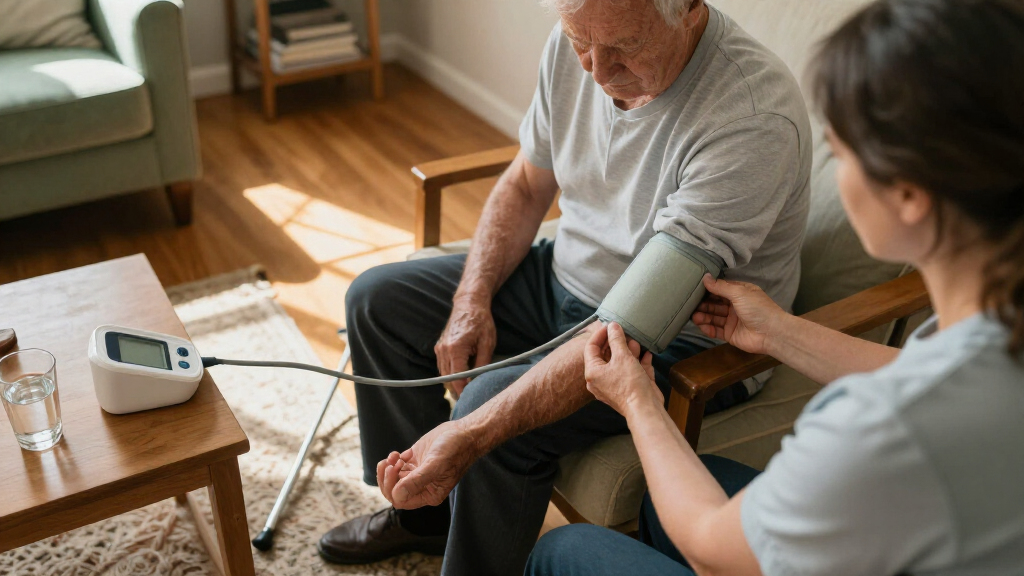
Wang encouraged older adults, family members and caregivers to consider regular home blood pressure measurements and share the readings with a health care team. That is the researcher’s recommendation, not a finding that home monitoring prevents falls. The American Heart Association guideline already recommends home readings as one part of blood pressure assessment and care. Individuals should discuss blood pressure monitoring and any treatment decisions with a qualified health professional.
As an affiliate, we earn on qualifying purchases.
Key Questions
What does masked high blood pressure mean?
It means blood pressure readings are normal in a medical office but high at home or outside the clinic. In this study, researchers compared readings from both settings.
How much higher was the reported fall rate?
Participants with masked high blood pressure had a 70% higher rate of falls than participants whose readings were high both in the office and at home. The report does not give the absolute fall rates for those groups.
Does the study prove masked high blood pressure causes falls?
No. The study found an association and did not establish that masked high blood pressure caused falls. Researchers also did not identify why the groups differed.
Who took part in the research?
The analysis included 758 adults older than 78. During a median follow-up of 350 days, 23.4% reported at least one fall in the previous 12 months.
What should older adults do with home blood pressure readings?
Study author Frances Wang encouraged older adults and caregivers to share home readings with a health care team. The American Heart Association also recommends home monitoring as part of blood pressure care. Monitoring does not replace professional advice; discuss measurement and care decisions with a qualified health professional.
Source: rss
Cold & flu season Picks
humidifiers
As an affiliate, we earn on qualifying purchases.