
TL;DR

Get health and wellness essentials delivered free with Prime
- Fast, free delivery on millions of items
- Prime Video, Amazon Music and more included
- Member-only deals all year
Fit&Well published a yoga therapist’s seven-part chair-based movement sequence intended for older adults and people who find floor-based exercise difficult. The therapist describes the movements as gentle and potentially energizing, but the report does not provide clinical evidence that the routine improves health or fitness.
Fit&Well has published a seven-part chair-based movement sequence recommended by a yoga therapist who works mainly with older adults, including people living with Parkinson’s disease, other movement disorders and chronic health conditions. The routine uses gentle stretches and mobility movements that can be done while seated, offering an option for people who find floor-based yoga difficult or prefer a chair.
The therapist says chair-based yoga can let participants explore mindful movement from a position they find more accessible. The reported sequence begins with one minute of settling into a supported seated position, with feet flat on the floor, the body upright and the breath allowed to return to its natural rhythm. A sturdy chair and enough space to lift the arms are the listed requirements.
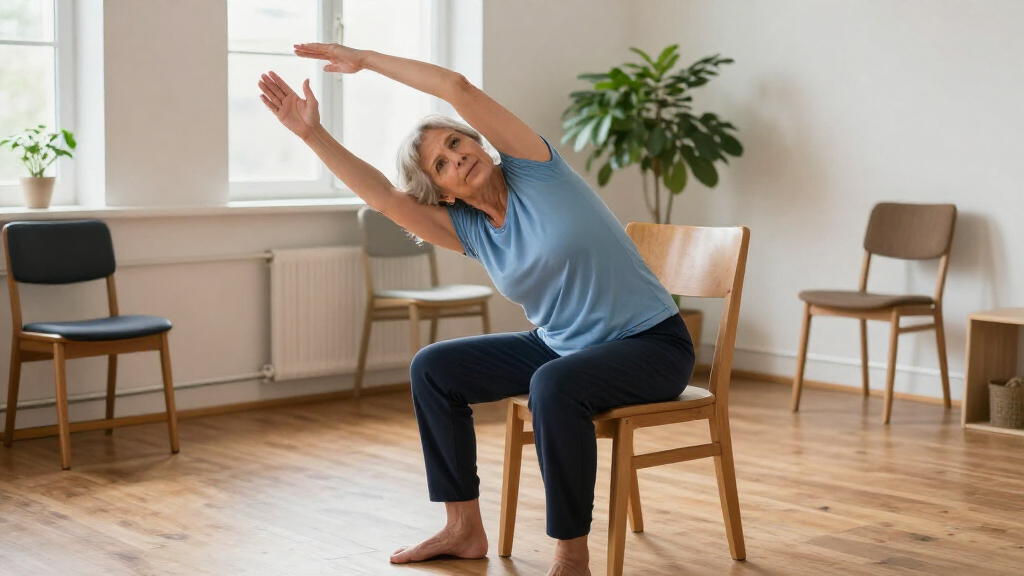
The remaining movements are an overhead arm sweep into prayer, seated torso twists, single- and double-arm raises, side bends, seated cat-cow and a forward fold. Most are suggested for three to five repetitions, while twists and side bends are done three times on each side. The instructions coordinate each movement with inhaling or exhaling.
The report includes ways to adapt some movements: participants can hold the chair for extra stability during a side bend, or keep their hands on their knees during the forward fold. The therapist advises moving within each person’s range and capacity, rather than trying to achieve a particular pose. The source does not provide a medical assessment of who should or should not do the routine.
A Seated Option for Gentle Movement
The routine’s practical value is its chair-based format: it offers movements that do not require getting down to or rising from the floor. That may make it relevant to older adults with limited mobility, as well as people who feel more comfortable exercising while seated. The therapist says the group movements are intended to stretch muscles, mobilize joints and support a calmer feeling in the body.
Those reported aims should not be confused with evidence of a proven health outcome. Fit&Well presents the sequence as guidance from a yoga therapist, not as a clinical trial or a treatment plan. Readers should treat claims that the flow can feel energizing as the therapist’s description of the experience, not a guaranteed result for everyone.
Products Worth Considering

Cuisinart MultiClad Pro 12-Piece Stainless Steel Cookware Set

Cuisinart Chef's Classic 7-Piece Stainless Steel Cookware Set

Cuisinart Chef's Classic 11-Piece Stainless Steel Cookware Set
As an affiliate, we earn on qualifying purchases.
How the Seven-Move Flow Works
The therapist says their work focuses mainly on older adults living with Parkinson’s, other movement disorders and chronic health conditions, and describes the postures used with those groups as gentle. They also say participants can leave feeling both more rested and uplifted. These are observations from the therapist’s work as reported by Fit&Well; the article does not give study data or participant measurements.
The sequence moves from settling and breathing into larger arm movements, rotation and side bending, then spinal movement and a forward fold. It can be followed in order, with the stated repetitions, but the therapist’s central instruction is to explore movement that feels accessible rather than reproduce a fixed shape. The report does not state how often to repeat the flow or how long the full sequence should take.
“I encourage everyone to move within the range and capacity of their body—there’s no particular shape or position to achieve.”
— The yoga therapist, as quoted in Fit&Well
Limits of the Published Guidance
The source does not identify the therapist by name in the supplied material, give a publication date, or describe any clinical study testing the sequence. It also does not specify whether the exercises are suitable for every person with Parkinson’s, another movement disorder or a chronic condition. Individual ability and safety needs vary, and the report does not set out screening criteria or instructions for pain, dizziness or other symptoms.
It is also unclear whether the routine has been assessed for changes in strength, balance, flexibility or other health measures. The therapist’s descriptions of feeling calmer, rested or energized are attributed experiences, not confirmed effects for all older adults. The source gives no recommended weekly schedule or progression plan.
Using the Routine With Care
Fit&Well’s report provides a sequence readers can follow using a stable chair, with modifications for the side bend and forward fold. The source offers no follow-up milestone or research results, so it remains a practical exercise recommendation rather than a reported clinical development. Anyone considering it can follow the therapist’s advice to stay within a comfortable range and avoid forcing a position.
People with health conditions or concerns about whether a movement is appropriate for them can ask a qualified health professional or suitably trained movement instructor for guidance before trying it. The report does not give individualized medical advice, and it does not say that chair yoga replaces other care or exercise prescribed for a specific condition.
Key Questions
What exercises are included in the chair routine?
The sequence includes settling and breathing, arm arcs into prayer, seated twists, arm raises, side bends, cat-cow and a forward fold. The instructions generally call for three to five repetitions, with twists and side bends performed on both sides.
What equipment is needed?
The report calls for a sturdy chair and enough clear space around it to raise the arms comfortably. It does not list other equipment.
Can the exercises be adapted?
Yes. Fit&Well’s instructions suggest holding the chair for more support during a side bend and placing the hands on the knees during the forward fold. The therapist also advises moving within each person’s own range and capacity.
Does the report prove that the routine improves health?
No. The source presents a yoga therapist’s recommendation and account of participant experience, but it does not report a clinical study or measured health outcomes. Descriptions such as feeling energized are not guaranteed effects.
Is the sequence suitable for everyone with a health condition?
The report does not establish that it is suitable for every person or condition. Anyone unsure whether the movements are appropriate can seek guidance from a qualified health professional before trying them.
Source: fitandwell.com