
TL;DR

Get health and wellness essentials delivered free with Prime
- Fast, free delivery on millions of items
- Prime Video, Amazon Music and more included
- Member-only deals all year
In a randomized trial in Pune, 125 healthy adults completed a 45-day study of a standardized yoga routine or a waitlist control. The yoga group reported better mood and sleep and performed better on selected short-term verbal memory measures; scans of a small subgroup showed changes in connectivity across several brain networks. The study does not establish that yoga caused lasting brain changes or that the results apply beyond the participants studied.
A randomized controlled study in India found that healthy adults who followed a standardized yoga routine for 45 days reported better mood and sleep and improved on selected short-term verbal memory measures compared with a waitlist control. Brain scans of a smaller subgroup also showed differences in connectivity across several networks, though the study does not show whether those changes last or produce broader cognitive benefits.
Researchers assigned 139 adults aged 18 to 55 to either the Common Yoga Protocol or a waitlist control. The study took place at a university in Pune from October 2023 to January 2025; 125 participants completed it. The yoga group attended sessions averaging about 50 minutes, combining loosening exercises, postures, breathing practices, guided relaxation and meditation. The control group received general advice to stay active and was offered yoga afterward.
Compared with controls, the yoga group’s Positive and Negative Affect Schedule scores indicated about 4 points higher positive affect and 3.5 points lower negative affect. Its sleep-quality score was about 1.2 points lower after adjustment for baseline scores, which the researchers interpreted as better self-reported sleep. On number-repetition tests, participants in the yoga group did better on the forward version and the combined score. There was no reported between-group difference on the backward version or a symbol-matching test.
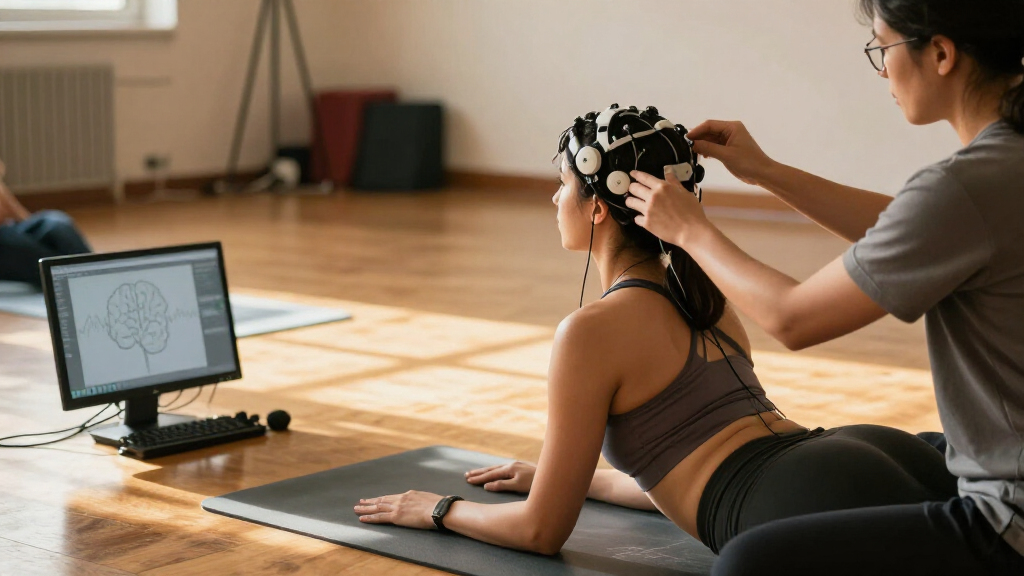
For imaging, 25 participants from each study arm were selected, but scans from 43 participants were included in the reported subgroup findings. Resting-state functional MRI showed altered connectivity involving networks associated with movement, attention, language and the cerebellum. The researchers also reported stronger links between some sensorimotor regions and frontal areas. These findings describe patterns in the scans; they do not establish that the changes improved everyday functioning.
What the Trial Adds to Yoga Research
The study adds randomized evidence on a defined, 45-day yoga program, rather than treating yoga as a single, uniform practice. Its combination of mood and sleep questionnaires, memory tests and brain imaging gives researchers several ways to examine whether changes reported by participants coincide with differences in brain-network communication.
The results may interest people studying low-cost approaches to well-being, but they should not be read as proof that yoga prevents mental health conditions or produces lasting cognitive gains. The measured improvements were limited to particular outcomes, and the scan analysis covered a small subset. The trial also compared the program with a waitlist, not with another structured activity matched for instructor attention, group contact or time commitment.
Products Worth Considering

Cuisinart CPG-256 8-in-1 Portable Wood Pellet Grill and Smoker

KitchenAid Classic Series 4.5-Quart Tilt-Head Stand Mixer, Onyx Black

Ninja Fireside360 Propane Fire Pit and Outdoor Heater, 80,000 BTU, 3 Modes, Cyberspace
As an affiliate, we earn on qualifying purchases.
How the Common Yoga Protocol Was Tested
The Common Yoga Protocol is a standardized routine designed by experts and used in this trial to make the intervention more consistent. Researchers said comparisons across earlier yoga studies can be difficult because programs differ in their mix of postures, breathing and meditation, as well as in frequency and duration. Randomized imaging studies of this specific protocol have been limited.
Participants were recruited through campus appeals and flyers and had to be able to read Hindi or English and attend classes and scanning. The study excluded people with prior yoga experience and several health, activity and substance-use circumstances, among other criteria. The main analyses included all randomized participants, with missing values replaced by group median scores. This approach and the selected sample shape how broadly the findings can be applied.
Limits of the Brain Scan Findings
The reported results do not establish whether the observed connectivity differences persist after the 45-day program, or whether they translate into meaningful changes in daily life. The imaging subgroup was small, and the supplied report does not give enough detail to assess the size and reliability of every network finding. It is also unclear whether participants continued practicing after the study or whether any benefits were maintained.
The trial was open-label, so participants knew whether they were taking yoga classes. Mood and sleep were self-reported, and the waitlist group did not receive an activity matched for time and social interaction. The study involved healthy adults aged 18 to 55; its findings do not directly establish effects for children, older adults, people with diagnosed conditions or experienced yoga practitioners.
Questions for Longer Follow-Up Studies
The next step is to test whether the reported effects remain over longer periods and whether they can be reproduced in larger, more diverse groups. Studies that compare yoga with another structured activity could help separate the effects of the routine itself from attention, social contact and regular scheduling.
Further research could also track practice after classes end, use repeated scans, and examine whether connectivity changes correspond to measurable differences in everyday memory, attention or sleep. Until such evidence is available, this trial supports a short-term association between the protocol and several measured outcomes, not a claim of lasting brain change.
Key Questions
What did participants do during the 45-day yoga program?
They attended sessions averaging about 50 minutes, including loosening exercises, postures, breathing practices, guided relaxation and meditation under one instructor.
What changed compared with the waitlist group?
The yoga group reported higher positive affect, lower negative affect and a lower sleep-quality score, interpreted by the researchers as better self-reported sleep. It also performed better on the forward number-repetition test and the combined score, but not on every cognitive test.
Did brain scans show that yoga permanently changed participants’ brains?
No. The scans showed differences in resting-state connectivity in a subgroup after 45 days. The study does not establish whether those differences lasted or affected daily functioning.
How many people completed the study and had scans?
125 of 139 randomized participants completed the study. The researchers selected 25 from each group for imaging, and the reported scan findings covered 43 participants.
Can the findings be applied to everyone?
The participants were healthy adults aged 18 to 55, with several groups excluded. The results do not establish the same effects for people with health conditions, older adults, children or experienced yoga practitioners.
Source: news-medical.net