
TL;DR

Get health and wellness essentials delivered free with Prime
- Fast, free delivery on millions of items
- Prime Video, Amazon Music and more included
- Member-only deals all year
A Fit&Well report recommends four exercises—chair-based knee lifts and sit-to-stands, a weighted leg raise, farmer carries and shoulder presses—to work strength and balance used in everyday activities. The routine suggests two rounds, with eight repetitions for each move and 30-second carries; it is a trainer’s recommendation, not a clinical finding that the exercises prevent falls or preserve independence.
Fit&Well has published a four-move strength and balance routine from a chair-workout instructor who works with older adults, presenting exercises aimed at everyday tasks such as standing from a seat, carrying shopping and reaching overhead. The suggested workout uses a sturdy chair and dumbbells, and calls for two rounds of the exercises.
The routine combines a seated knee lift followed by a sit-to-stand, a standing leg raise while holding a dumbbell, a farmer carry with weights in both hands, and a shoulder press. The report recommends eight repetitions of each move—or eight per side where relevant—and a 30-second farmer carry, with 30 seconds of rest between carries. It advises choosing weights that can be controlled throughout each movement.
The instructor links each exercise to a practical movement. Knee lifts and sit-to-stands rehearse moving the legs and rising from a low seat; the one-sided leg raise challenges balance; carrying weights resembles carrying grocery bags; and shoulder presses work muscles used to lift objects onto a high shelf. These are the report’s explanations for including the moves, rather than measured results from a trial of this particular routine.
In describing classes for people from their late 60s into their 90s, the instructor recounts clients’ experiences after doing strength training. Examples include a client whose upper-body strength helped her get out of a hospital bed after hip replacement, and others who found it easier to get into a car, swim longer or walk farther. Those accounts are personal examples reported by the instructor; the article does not provide independent verification or data showing how common such outcomes are.
Training for Everyday Independence
The routine focuses on abilities that can affect how easily people manage daily life: standing up, walking while carrying items and reaching overhead. Presenting exercises around those tasks may help readers understand the practical purpose of strength and balance work, rather than treating exercise only as a fitness goal.
The instructor also argues that it is useful to build strength before later life, including in people’s 40s and 50s. That is the report’s recommendation, not a claim that this specific set of four exercises guarantees independence or prevents falls. The source describes client anecdotes but does not report clinical testing, injury rates or long-term outcomes for the routine.
chair exercise dumbbells for seniors
As an affiliate, we earn on qualifying purchases.
As an affiliate, we earn on qualifying purchases.
How the Four Moves Are Set Up
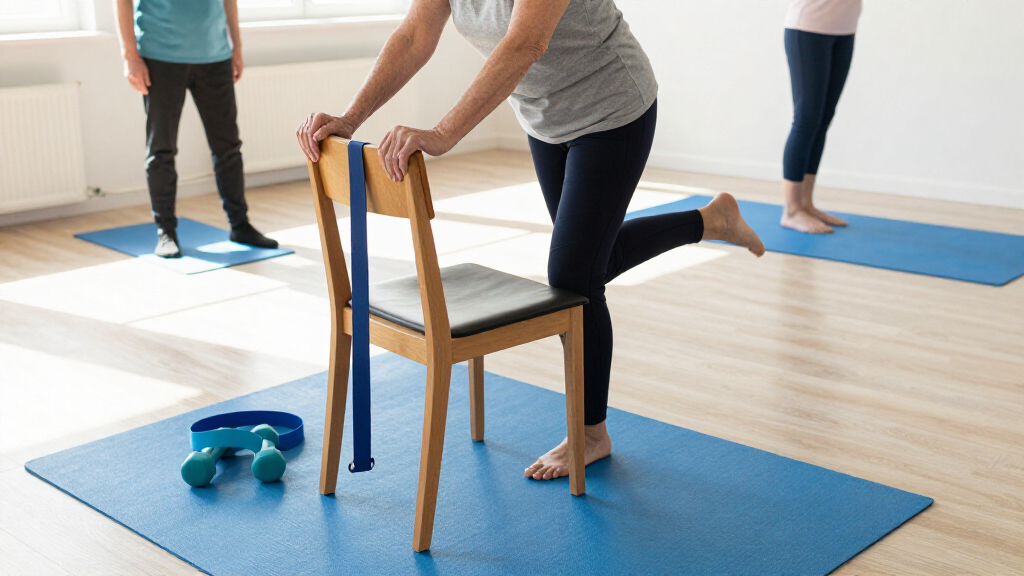
The exercises require a sturdy chair and a pair of dumbbells. For the first movement, the participant sits near the front of the chair, lifts each knee in turn, then stands and sits back down under control. The chair can be used for balance during the knee lifts if needed.
For the leg raise, the participant holds one dumbbell and lifts the opposite leg out to the side without leaning, then changes sides. The farmer carry involves walking with one dumbbell in each hand while keeping the torso upright. The shoulder press can be done seated or standing, pressing weights from shoulder height overhead and lowering them slowly. The report recommends two sets or rounds and controlled movement, but does not give a tailored progression plan.
lightweight dumbbells for elderly strength training
As an affiliate, we earn on qualifying purchases.
As an affiliate, we earn on qualifying purchases.
Evidence and Individual Suitability
The source does not identify a study testing this four-exercise routine, quantify its effects or establish that it reduces falls, prevents disability or produces the outcomes described in the client stories. It also does not specify how often to do the routine, how to increase weights over time, or how to adapt the moves for particular health conditions or mobility limitations.
The article gives general instructions but does not assess individual readers’ balance, strength or ability to exercise safely. Anyone unsure whether a move or weight is suitable should seek guidance from a qualified health or exercise professional. The source does not provide a clinical screening protocol or individualized advice.
As an affiliate, we earn on qualifying purchases.
Using the Routine Safely
The report presents the four exercises as a suggested routine, with two rounds and the stated repetition and carry timings. It does not announce a follow-up study, a formal training programme or a schedule for future updates. Readers who use the routine can follow the article’s stated guidance to select controllable weights and move with control, while seeking professional advice if they have concerns about their ability to perform it.
Whether this particular combination improves strength or balance over time remains unmeasured in the source material. Any future evidence would need to assess outcomes beyond the instructor’s client anecdotes to establish the routine’s effects and who is most likely to benefit.
balance exercise equipment for seniors
As an affiliate, we earn on qualifying purchases.
As an affiliate, we earn on qualifying purchases.
Key Questions
Which four exercises does the report recommend?
It lists a seated knee lift followed by a sit-to-stand, a dumbbell hold with a side leg raise, a farmer carry and a shoulder press.
How many repetitions and rounds are suggested?
The report recommends eight repetitions per exercise, or per side where applicable, and two rounds overall. It prescribes a 30-second farmer carry and 30 seconds of rest between carries.
What equipment is needed?
The routine calls for a sturdy chair and a pair of dumbbells. The instructor advises using weights that can be controlled throughout each movement.
Does the report show that these exercises prevent falls?
No. It describes the moves as working strength and balance related to daily tasks, but provides no trial results or evidence that this specific routine prevents falls.
Can the routine be adapted for individual health needs?
The report offers some basic options, such as doing shoulder presses seated or standing and using the chair for balance during knee lifts. It does not provide individualized medical guidance; people uncertain about suitability can consult a qualified health or exercise professional.
Source: rss
Cold & flu season Picks
humidifiers
As an affiliate, we earn on qualifying purchases.