
TL;DR

Get health and wellness essentials delivered free with Prime
- Fast, free delivery on millions of items
- Prime Video, Amazon Music and more included
- Member-only deals all year
Personal trainer Pippa Sealey says shorter rest periods and unilateral exercises can make home dumbbell workouts more challenging when heavier weights are unavailable. Her sample routine combines those methods in supersets and tri-sets, but the report does not provide evidence that the workout suits every fitness level.
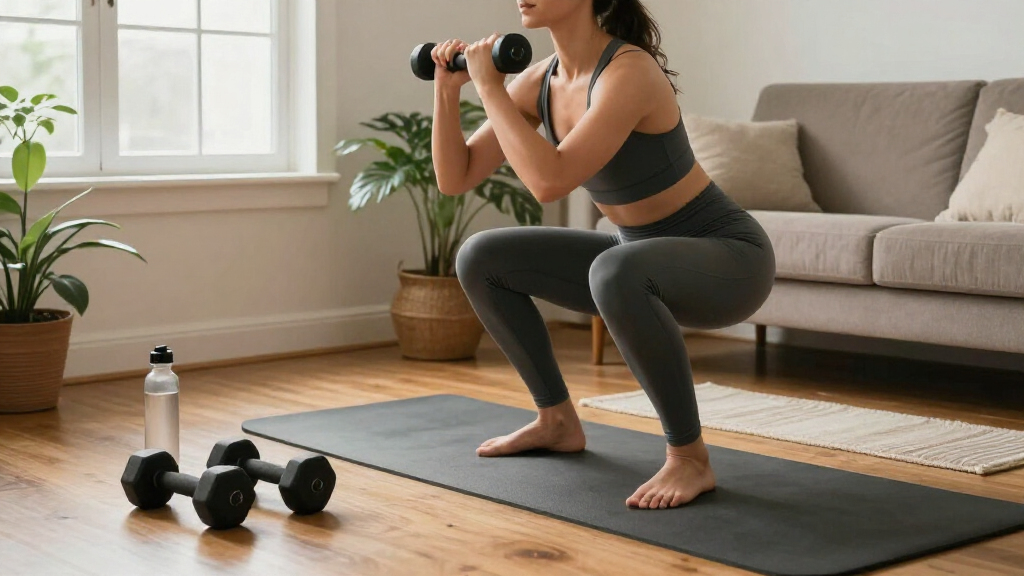
Personal trainer Pippa Sealey recommends using shorter rest periods and unilateral exercises to make home dumbbell workouts more challenging when heavier weights are not available. In a Fit&Well report, she shared a sample routine built around supersets and tri-sets for people already comfortable with basic movements such as squats and deadlifts.
Sealey’s two methods change the way a workout is organized rather than requiring additional equipment. Shorter rests reduce the pause between exercises, while unilateral movements train one side of the body at a time. The report presents both as ways to raise the challenge when someone has limited access to heavier loads; it does not claim that they replace progressive increases in weight for every trainee.
The routine groups exercises into sequences. A superset pairs two movements, while a tri-set adds a third; participants complete the sequence before resting, then repeat it three times before moving to the next group. The listed exercises include calf raises, hamstring bridge marches, wall sits, single-leg Romanian deadlifts, split squats, push-ups, a single-arm dumbbell row, side-plank hip lifts, plank dumbbell pull-throughs and dumbbell sit-ups. One listed sequence pairs a single-leg Romanian deadlift with a split squat.
The workout includes both bodyweight and dumbbell movements. The instructions prescribe three rounds for the groups, with some exercises performed for a set number of repetitions and others for a timed hold or as many repetitions as can be completed with good form. Rest is generally listed as zero seconds between paired movements, followed by 60 to 90 seconds after particular groups. That structure is the report’s example, not a universal prescription.
How the Workout Adds Challenge
For people training at home with a limited set of weights, the advice offers ways to vary a session without buying more equipment. Working one limb at a time can make a movement more demanding with the same dumbbell, while pairing exercises and limiting pauses can increase the work completed in a session. These are practical programming options rather than proof of a particular result.
The report also makes clear that the sample is aimed at people who already know fundamental exercises. Several moves require balance, trunk control or coordination, and the push-up instruction says to stop when good form can no longer be maintained. Readers should not treat the routine as appropriate for all abilities or as a substitute for individualized coaching.
adjustable dumbbells for home workouts
As an affiliate, we earn on qualifying purchases.
As an affiliate, we earn on qualifying purchases.
Why Sealey Uses Supersets
Sealey’s stated rationale is that people at home may not have access to heavy loads. She says she uses shorter rests and one-sided movements in that situation. The report also describes “agonist supersets,” which pair exercises aimed at the same muscle group to increase the challenge to that area.
In the published workout, the groups mix lower-body, upper-body and core movements. Rest instructions vary by group, so the routine is not simply a continuous circuit with no breaks. The report gives movement directions and repetitions, but does not set out a weekly schedule, a progression plan or a method for choosing a suitable dumbbell weight.
“You may also want to use more agonist supersets.”
— Pippa Sealey, as quoted by Fit&Well
non-slip exercise mat for strength training
As an affiliate, we earn on qualifying purchases.
As an affiliate, we earn on qualifying purchases.
Limits of the Published Routine
The source does not give a publication date, identify a study testing the routine, or report measured results from people following it. It also does not specify how often to perform the workout, how to select weights, or how to adjust the exercises for injuries, limited mobility or different experience levels. The report’s guidance is attributed to Sealey and should not be read as evidence that the same format will produce the same outcome for everyone.
The exercise list includes a single-arm dumbbell push press in its instructions, while the overview’s third group lists a push-up and a single-arm dumbbell row. The supplied report excerpt does not explain that difference or provide full instructions for every listed movement. Readers should refer to the original workout details before attempting exercises whose setup or technique is not described here.
resistance bands for home strength workouts
As an affiliate, we earn on qualifying purchases.
As an affiliate, we earn on qualifying purchases.
How Readers Can Apply the Advice
The report does not announce a follow-up study or a new program. Its immediate takeaway is to use shorter rests and unilateral movements as optional ways to vary home sessions, with the sample workout serving as an example for people familiar with its underlying movements.
Anyone adapting the routine would need to choose a load and variation they can control, and retain enough rest to maintain technique. The published instructions specifically call for controlled repetitions and good form; the report does not provide individualized coaching or medical guidance.
Key Questions
What two methods does Pippa Sealey recommend?
Sealey recommends shorter rest periods and unilateral exercises, which train one side of the body at a time, when heavier weights are not available at home.
What is a superset in this workout?
A superset means completing one set of an exercise and then a set of another exercise before resting. The report also describes tri-sets, which add a third exercise to the sequence.
Who is the sample workout designed for?
Fit&Well describes it as a routine for people already confident with fundamental movements such as squats and deadlifts. The source does not say it is suitable for every fitness level.
Does the report say heavier dumbbells are unnecessary?
No. Sealey suggests ways to increase a workout’s challenge when heavier loads are not accessible. The report does not say those methods replace heavier weights or other forms of progression in every training plan.
How often should someone do this workout?
The supplied report does not specify a weekly frequency. It gives exercise sequences and sets, but not a schedule for repeating the session.
Source: rss
Halloween Picks
halloween
As an affiliate, we earn on qualifying purchases.