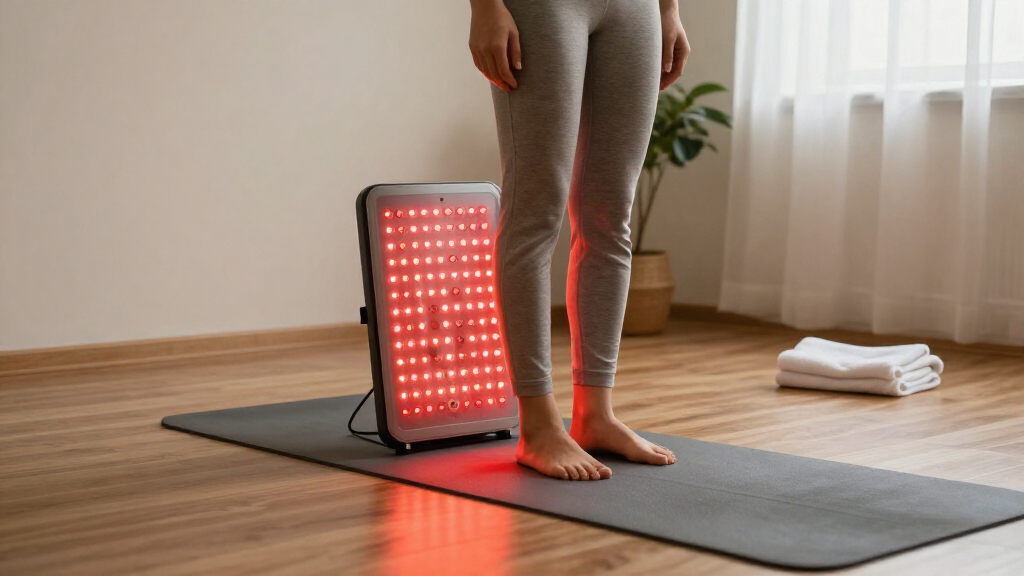
For a versatile starting point, I’d put the Hooga PRO300 first: its body-and-face positioning offers a useful middle ground between compact lamps and larger panels. The BestQool Pro300 stands out for shoppers who want four wavelengths, while the INIA 2-in-1 Panel and Belt offers a different approach for people who want both a panel and a wearable format. The main tradeoffs are coverage versus portability, simpler two-wavelength designs versus added wavelength options, and a fixed setup versus more flexible use. A larger panel can cover more area at once, but it needs more room and can be less convenient to reposition. Continue reading for the full breakdown of all 15 red light therapy panels and how their differences may fit your needs.

Get health and wellness essentials delivered free with Prime
- Fast, free delivery on millions of items
- Prime Video, Amazon Music and more included
- Member-only deals all year
Key Takeaways
- The lineup splits into clear size tiers: compact options such as the BestQool BQ60 and Hooga HG200 favor focused use, while the PRO300 and ULTRA360 are better suited to shoppers prioritizing a larger panel format.
- Four-wavelength models are not automatically the best fit: the BestQool Pro100, Pro200, and Pro300 add wavelength variety, while simpler 660nm-and-850nm options may be easier to choose if you want a less complex setup.
- Format changes the routine: the INIA combines a panel with a belt, while stand-equipped Viconor and 300-LED panels emphasize positioning flexibility rather than a wearable option.
- Brand families offer useful comparison points: Hooga’s HG200, PRO300, HG300, and ULTRA360 span different panel sizes and tiers; BestQool’s BQ60 and Pro-series models likewise range from compact to more feature-rich.
- More LEDs or listed wattage alone do not settle the choice: coverage, distance, session guidance, physical footprint, and whether the panel can be positioned comfortably matter just as much for everyday usability.
| Red Light Therapy Panel with Stand, 300 LEDs, 5 Wavelengths |  | Best for Full-Body Coverage | LED count: 300 | Stated power output: 1500 W | Wavelengths: 630, 660, 810, 830, and 850 nm | VIEW LATEST PRICE | See Our Full Breakdown |
| BestQool Pro200 Red Light Therapy Panel, 4 Wavelengths, 200 LEDs, 330W |  | Best for Expandable Setups | Model: Pro200 | LED count: 200 | Wavelength count: 4 | VIEW LATEST PRICE | See Our Full Breakdown |
| INIA 2-in-1 Red Light Therapy Panel and Belt |  | Best for Wearable Flexibility | Design: Panel and wearable belt | LED count: 360 | Wavelengths: 630, 660, 850, and 1064 nm | VIEW LATEST PRICE | See Our Full Breakdown |
| Hooga PRO300 Red Light Therapy Panel for Body and Face |  | Best for Tabletop Control | Model: PRO300 | LEDs: 60 dual-chip LEDs | Wavelengths: 660 nm red and 850 nm near-infrared | VIEW LATEST PRICE | See Our Full Breakdown |
| Hooga HG200 Red Light Therapy Panel for Face & Body |  | Best Compact Starter Panel | Model: HG200 | LEDs: 40 LEDs, 5 W each | Wavelengths: 660 nm red and 850 nm near-infrared | VIEW LATEST PRICE | See Our Full Breakdown |
| Viconor Red Light Therapy Lamp for Face and Body with Stand |  | Best for Flexible Placement | LED count: 120 | Wavelengths: 660 nm red and 850 nm near-infrared | Panel design: Curved | VIEW LATEST PRICE | See Our Full Breakdown |
| 45W Red Light Therapy Panel with 660nm Red and 850nm Near-Infrared LEDs |  | Best for Simple, Low-Spec Setup | Power: 45W | Wavelengths: 660 nm red and 850 nm near-infrared | Mounting: Can be hung or placed independently | VIEW LATEST PRICE | See Our Full Breakdown |
| Viconor Red Light Therapy Panel, 660 nm and 850 nm, 60 Dual-Chip LEDs |  | Best for Timed Sessions | Brand: Viconor | Wavelengths: 660 nm and 850 nm | LED configuration: 60 dual-chip LEDs (120 chips total) | VIEW LATEST PRICE | See Our Full Breakdown |
| Hooga HG300 Red and Near-Infrared Light Therapy Panel |  | Best for Targeted Sessions | Wavelengths: 660 nm red and 850 nm near-infrared | LED count: 60 | Irradiance: Over 73 mW/cm² at 6 inches | VIEW LATEST PRICE | See Our Full Breakdown |
| Hooga ULTRA360 Red Light Therapy Panel |  | Best for Wavelength and Control Options | Model: ULTRA360 | LED count and type: 72 quad-chip LEDs | Wavelengths: 630 nm, 660 nm, 810 nm, and 850 nm | VIEW LATEST PRICE | See Our Full Breakdown |
| BestQool BQ60 Red Light Therapy Panel, 660nm Red and 850nm Near-Infrared, 105W |  | Best for Flexible Positioning | Power: 105W | Wavelengths: 660nm red and 850nm near-infrared | Irradiance: 95.6 mW/cm² at 3 inches | VIEW LATEST PRICE | See Our Full Breakdown |
| Morfone Red Light Therapy Panel, 660nm, 850nm and 940nm |  | Best for Multi-Mode Targeting | LED beads: 120 | Wavelengths: 660nm, 850nm, and 940nm | Lighting modes: Five, including pulse mode | VIEW LATEST PRICE | See Our Full Breakdown |
| BestQool Pro300 Red Light Therapy Panel, 4 Wavelengths, 470W |  | Best for Expandable Coverage | Wavelengths: 630nm, 660nm, 850nm, and 940nm | LEDs: 300 | Irradiance: Exceeds 106 mW/cm² at 3 inches | VIEW LATEST PRICE | See Our Full Breakdown |
| Viconor Red Light Therapy Lamp for Face and Body |  | Best for Curved-Panel Placement | LED count: 120 | Wavelengths: 660nm red and 850nm near-infrared | Design: Curved panel | VIEW LATEST PRICE | See Our Full Breakdown |
| BestQool Pro100 Red Light Therapy Panel, 4 Wavelengths, 160W |  | Best Compact Modular Panel | Wavelengths: 4 | Power: 160W | Modes: 3 | VIEW LATEST PRICE | See Our Full Breakdown |
| red light therapy panel | Wavelengths | Irradiance | Power |
|---|---|---|---|
| Red Light Therapy Panel with S | 630, 660, 810, 830, and 850 nm | 194 mW/cm² at 3 inches | — |
| BestQool Pro200 Red Light Ther | — | Over 111 mW/cm² at 3 inches | 330 W |
| INIA 2-in-1 Red Light Therapy | 630, 660, 850, and 1064 nm | — | — |
| Hooga PRO300 Red Light Therapy | 660 nm red and 850 nm near-infrared | — | 300 W |
| Hooga HG200 Red Light Therapy | 660 nm red and 850 nm near-infrared | Over 90 mW/cm² at 6 inches | — |
| Viconor Red Light Therapy Lamp | 660 nm red and 850 nm near-infrared | — | — |
| 45W Red Light Therapy Panel wi | 660 nm red and 850 nm near-infrared | — | 45W |
| Viconor Red Light Therapy Pane | 660 nm and 850 nm | 140 mW/cm² at 6 inches | 300W |
| Hooga HG300 Red and Near-Infra | 660 nm red and 850 nm near-infrared | Over 73 mW/cm² at 6 inches | 300W |
| Hooga ULTRA360 Red Light Thera | 630 nm, 660 nm, 810 nm, and 850 nm | — | — |
| BestQool BQ60 Red Light Therap | 660nm red and 850nm near-infrared | 95.6 mW/cm² at 3 inches | 105W |
| Morfone Red Light Therapy Pane | 660nm, 850nm, and 940nm | — | — |
| BestQool Pro300 Red Light Ther | 630nm, 660nm, 850nm, and 940nm | Exceeds 106 mW/cm² at 3 inches | 470W |
| Viconor Red Light Therapy Lamp | 660nm red and 850nm near-infrared | — | — |
| BestQool Pro100 Red Light Ther | 4 | 109 mW/cm² at 3 inches | 160W |
More Details on Our Top Picks
Red Light Therapy Panel with Stand, 300 LEDs, 5 Wavelengths
For shoppers who want one panel to cover larger areas, this model pairs 300 LEDs with a 35.4-inch panel and a wheeled, rotating stand. Its five wavelengths span 630–850 nm, giving it a broader listed range than the Hooga PRO300, which uses 660 nm red and 850 nm near-infrared. The 30° beam angle and stated irradiance of 194 mW/cm² at three inches favor close-range sessions, while the digital timer and remote simplify adjustments without reaching the panel. The tradeoff is scale: its footprint and power demand suit a dedicated treatment area better than a cramped room. The product data also gives no FDA-clearance or clinical-validation details, so I would not treat its high output claims as evidence of medical effectiveness.
Pros:- Large 35.4 × 11.8-inch panel and rotating stand support broad, adjustable coverage.
- Five listed wavelengths cover a wider range than the two-wavelength Hooga PRO300.
- Remote and digital timer make timed sessions easier to manage.
- Built-in cooling fan supports operation during sessions.
Cons:- Large dimensions and wheeled stand can be awkward in small rooms.
- High stated power output may mean greater electricity use than compact panels.
- No FDA-clearance or clinical-validation information is provided.
Best for: People setting up a dedicated home treatment area who want a large, adjustable panel for targeting multiple body regions.
Not ideal for: Apartment dwellers or anyone seeking a compact panel for occasional face-focused sessions; the large frame and wheeled stand need storage space.
- LED count:300
- Stated power output:1500 W
- Wavelengths:630, 660, 810, 830, and 850 nm
- Irradiance:194 mW/cm² at 3 inches
- Dimensions:35.4 × 11.8 inches
- Beam angle:30°
- Modes:3 adjustable modes
- Stand and rotation:Wheeled stand; 360° rotatable panel
- Controls and cooling:Digital timer, remote control, and built-in cooling fan
Our verdict“Choose this panel if broad coverage and stand mobility matter more than compact storage or a smaller setup.”
BestQool Pro200 Red Light Therapy Panel, 4 Wavelengths, 200 LEDs, 330W
The Pro200 makes the most sense for buyers who may want to build out their setup over time. Its modular connection system lets multiple panels link together, unlike the standalone Hooga HG200, which is designed as a compact tabletop unit. The Pro200 also offers four wavelengths, three modes, and 200 LEDs, giving it more listed versatility than that smaller two-wavelength Hooga. Freestanding or wall-mounted placement helps adapt it to a room, and the stated irradiance is over 111 mW/cm² at three inches. The compromise is that this is still a substantial panel, not a casual desk lamp; plan for dedicated space. The description mentions a mobile stand as an option but does not clarify whether one is included, so buyers should confirm what comes in the box.
Pros:- Modular design allows multiple panels to be connected for expanded coverage.
- Freestanding or wall-mounted placement offers more setup choices than a tabletop-only panel.
- Four wavelengths and three modes provide more options than the Hooga HG200.
- Flicker-free design and stated zero EMF at six inches are listed features.
Cons:- Panel size may require a dedicated location.
- Whether a mobile stand is included is unclear from the product information.
- Its stated irradiance is measured at three inches, so the figure does not describe output at greater distances.
Best for: Home users planning a fixed treatment space who want the option to connect additional panels for wider coverage.
Not ideal for: Buyers needing a clearly specified, ready-to-roll stand or a compact unit that can be put away after each session.
- Model:Pro200
- LED count:200
- Wavelength count:4
- Power:330 W
- Modes:3
- Irradiance:Over 111 mW/cm² at 3 inches
- EMF:Zero EMF at 6 inches, as stated
- Mounting:Freestanding or wall-mounted
- Expandability:Multiple devices can be connected
Our verdict“Pick the Pro200 if you want a four-wavelength panel that can become part of a larger connected setup.”
INIA 2-in-1 Red Light Therapy Panel and Belt
The INIA stands apart from conventional panels by combining a large panel with a wearable belt. That pairing gives users a way to position light around areas such as the back or waist while keeping a panel format for broader treatment; the Hooga PRO300, by comparison, is a tabletop panel with a fixed stand and no wearable component. INIA lists four wavelengths, including 1064 nm, plus steady and two pulsed settings, so it offers more mode and wavelength variety than the two-wavelength Hooga. The product is described for wireless use, which may suit routines away from an outlet. However, no battery runtime, charging details, dimensions, or irradiance measurements are supplied. Those omissions make it harder to judge session planning and coverage, so this is a flexible-format choice rather than a data-rich pick.
Pros:- Panel-and-belt combination offers more ways to position the device than the Hooga PRO300.
- Four listed wavelengths include 1064 nm.
- Steady, 10 Hz pulse, and 40 Hz pulse settings provide three operating modes.
- Wireless-use design avoids being tied to a nearby outlet during use.
Cons:- Battery life and charging details are not provided.
- No irradiance figure makes output comparisons difficult.
- Dimensions are not listed, limiting buyers’ ability to judge panel coverage and storage needs.
Best for: People who want both a broad panel and a wearable option for targeting the back, waist, legs, or shoulders.
Not ideal for: Spec-focused buyers who need published irradiance, physical dimensions, or battery and charging information before choosing a device.
- Design:Panel and wearable belt
- LED count:360
- Wavelengths:630, 660, 850, and 1064 nm
- Modes:Steady, Pulse 10 Hz, and Pulse 40 Hz
- Power use:Wireless use
Our verdict“Choose the INIA if wearable placement matters more to you than published output and battery specifications.”
Hooga PRO300 Red Light Therapy Panel for Body and Face
The PRO300 is a strong fit for buyers who want straightforward control over two familiar light bands in a tabletop format. Its independent red and near-infrared controls let users select 660 nm, 850 nm, or both, a useful distinction from the BestQool Pro200, which lists four wavelengths and a modular expansion path. Hooga keeps the setup more focused: an adjustable tabletop stand, digital timer, cooling fans, and a three-year warranty are included in the product details. Its 60 dual-chip LEDs and 60° beam angle make it a more compact-style alternative to the 300-LED full-body panel, but the tabletop placement can limit where it fits and how it targets larger areas. At 4.3 kg, it is also substantial enough that frequent moving may be inconvenient.
Pros:- Independent controls allow red and near-infrared light to be selected separately or together.
- Adjustable tabletop stand and digital timer support a controlled home setup.
- Cooling fans and flicker-free design are listed features.
- Three-year manufacturer warranty is specified.
Cons:- Tabletop mounting limits placement compared with freestanding or wall-mounted alternatives.
- At 4.3 kg, it may be cumbersome to move and reposition regularly.
- Two wavelengths provide less variety than the four-wavelength BestQool Pro200.
Best for: Buyers who want a tabletop panel with separate red and near-infrared controls, a timer, and a stated warranty.
Not ideal for: People seeking a wearable device, a wall-mounted or wheeled setup, or the broader wavelength selection offered by the BestQool Pro200.
- Model:PRO300
- LEDs:60 dual-chip LEDs
- Wavelengths:660 nm red and 850 nm near-infrared
- Power:300 W
- Beam angle:60°
- Dimensions:61.2 × 15.7 × 3.1 inches
- Weight:4.3 kg
- Mounting and included components:Adjustable tabletop stand; panel and power cord
- Warranty:3 years
Our verdict“Choose the PRO300 if tabletop placement and separate wavelength controls matter more than portability or a wider wavelength set.”
Hooga HG200 Red Light Therapy Panel for Face & Body
The HG200 is the simplest fit here for someone starting with a small tabletop panel rather than dedicating floor space to a larger rig. At 9.8 × 6.3 inches, it is much easier to place or store than the Hooga PRO300, while keeping the same listed 660 nm red and 850 nm near-infrared wavelengths. A built-in timer, adjustable stand, and mode switching make routine setup fairly direct, and the listed irradiance is over 90 mW/cm² at six inches. The tradeoff is coverage: its 40 LEDs and compact face make it less suited to treating broad body areas in one position than larger panels such as the 300-LED model in this roundup. It is corded, not water-resistant, and the product information calls for eye protection, so it needs a dry, supervised setup.
Pros:- Compact 9.8 × 6.3-inch size is easier to place and store than the Hooga PRO300.
- Red, near-infrared, or combined modes offer simple light selection.
- Built-in timer, adjustable stand, and cooling fan support routine home use.
- Three-year manufacturer warranty is listed.
Cons:- Small panel limits coverage compared with larger full-body options.
- Corded operation restricts placement near a power outlet.
- Not water-resistant; the product information calls for eye protection and adult supervision.
Best for: First-time panel buyers who want a compact, corded tabletop device for localized face or body sessions.
Not ideal for: People seeking broad full-body coverage, wireless use, or a device suitable for humid bathroom environments.
- Model:HG200
- LEDs:40 LEDs, 5 W each
- Wavelengths:660 nm red and 850 nm near-infrared
- Total wattage:48 W
- Irradiance:Over 90 mW/cm² at 6 inches
- Dimensions:9.8 × 6.3 × 1.2 inches
- Power and mounting:Corded electric; tabletop stand
- Features:Built-in timer, cooling fan, and mode switching
- Warranty:3 years
Our verdict“Pick the HG200 if you want an easy-to-place starter panel for localized sessions rather than broad body coverage.”
Viconor Red Light Therapy Lamp for Face and Body with Stand
The Viconor lamp is a fit for buyers who want more placement options than a fixed tabletop panel. Its curved 120-LED design combines 660 nm red light with 850 nm near-infrared light, and the stand adjusts through 180 degrees so you can angle it toward a chosen area. It can also hang from the included hook, unlike the Hooga HG300, which is set up around its adjustable tabletop stand. That flexibility matters when your preferred position changes between face and body sessions. The tradeoff is coverage: the panel is described as small, so it is better suited to targeted use than broad-area treatment. Daily sessions are recommended, and the supplied details do not give an irradiance figure to help compare output.
Pros:- Combines 660 nm red and 850 nm near-infrared light
- Stand adjusts up to 180 degrees for flexible aiming
- Can be hung or used independently
- Designed for both face and body use
Cons:- Small panel limits the treatment area at one time
- Daily sessions are recommended
- No irradiance figure is supplied for output comparison
Best for: Home users who want to angle or hang a compact panel for targeted face and body sessions
Not ideal for: Buyers seeking broad body coverage or a clearly specified irradiance level before choosing a panel
- LED count:120
- Wavelengths:660 nm red and 850 nm near-infrared
- Panel design:Curved
- Stand adjustment:Up to 180°
- Power cord:1.8 m
- Placement:Can be hung or placed independently
- Included accessories:Stand and hook
Our verdict“Choose this Viconor if adjustable positioning and hanging options matter more to you than wide coverage or specified irradiance.”
45W Red Light Therapy Panel with 660nm Red and 850nm Near-Infrared LEDs
This 45W panel is the straightforward choice in this group: it pairs 660 nm red with 850 nm near-infrared light and can be hung or placed on a surface. That basic flexibility makes it easier to fit into a home routine than a panel with only one mounting arrangement. Compared with the Viconor 120-LED lamp, though, the listing gives less practical detail: it does not state dimensions, LED count, or treatment-area coverage. Those omissions make it hard to tell whether it will suit a particular space or how much area it can address at once. I’d shortlist it only if the simple wavelength pairing and flexible placement meet your needs; its supplied information does not support a more confident comparison of output or performance.
Pros:- Combines 660 nm red and 850 nm near-infrared wavelengths
- Can be hung or placed independently
- 45W power is specified
- Simple setup suits home use
Cons:- No dimensions or treatment-area details are provided
- No LED count or irradiance figure is supplied
- The available product details do not substantiate performance claims
Best for: Buyers who want a basic red-and-near-infrared panel that can be hung or set down and do not need detailed coverage specifications
Not ideal for: Shoppers comparing panels by treatment area, LED count, or measured irradiance, since those details are not supplied
- Power:45W
- Wavelengths:660 nm red and 850 nm near-infrared
- Mounting:Can be hung or placed independently
- Use:Home use
- LED count:Not specified
- Dimensions:Not specified
Our verdict“Pick this panel for a simple, flexible home setup only if the missing coverage and output details are not deal-breakers.”
Viconor Red Light Therapy Panel, 660 nm and 850 nm, 60 Dual-Chip LEDs
Compared with the 45W Red Light Therapy Panel, this Viconor gives buyers more defined session controls: a 5–30 minute timer and built-in cooling fan are listed, alongside a stated irradiance of 140 mW/cm² at 6 inches. Its 60 dual-chip LEDs provide 660 nm red and 850 nm near-infrared light, while the included hanging kit supports tabletop or wall placement. Those details make it easier to plan a set session than with simpler panels that omit a timer. The stated 300W power and irradiance are product specifications, not independent evidence of health outcomes. The main drawback is fit information: dimensions and weight are missing, so I can’t judge how much area it covers or how convenient it is to move. Eye protection is included, but the listing still leaves key sizing questions open.
Pros:- 5–30 minute timer supports set session lengths
- Built-in cooling fan is included
- Provides a stated irradiance at a specified distance
- Includes eye protection and a hanging kit
Cons:- Panel dimensions and weight are not provided
- The supplied information does not substantiate health or performance benefits
- The 660 nm and 850 nm pairing offers fewer listed wavelengths than the Hooga ULTRA360
Best for: Home users who want a timer, cooling fan, stated irradiance, and tabletop or wall placement
Not ideal for: Buyers who need confirmed panel dimensions and weight to plan storage, mounting, or treatment coverage
- Brand:Viconor
- Wavelengths:660 nm and 850 nm
- LED configuration:60 dual-chip LEDs (120 chips total)
- Power:300W
- Irradiance:140 mW/cm² at 6 inches
- Timer:5–30 minutes
- Cooling:Built-in cooling fan
- Included accessories:Hanging kit, eye protection, and user manual
Our verdict“Choose this Viconor if timed sessions and listed output figures matter more than confirmed size or multiple wavelength options.”
Hooga HG300 Red and Near-Infrared Light Therapy Panel
The Hooga HG300 is the most clearly defined compact option here for buyers treating smaller areas. Its 12.6 × 4.92-inch body, adjustable tabletop stand, and included protective eyewear make the setup details more concrete than the Viconor 120-LED lamp, whose dimensions are not supplied. Independent controls let you adjust the 660 nm red and 850 nm near-infrared lights separately, while the built-in timer and active cooling add session-management features. The stated irradiance is over 73 mW/cm² at 6 inches, giving a distance-specific figure, though it should not be treated as proof of a particular result. Its compact size is also its main limitation: it is designed for targeted sessions, not efficient coverage of larger body areas. The three-year warranty and listed LED lifespan add useful ownership information.
Pros:- Compact dimensions and adjustable tabletop stand make placement straightforward
- Independent controls for red and near-infrared light
- Includes protective eyewear, timer, and active cooling
- Lists a 3-year warranty and 50,000+ hour LED lifespan
Cons:- Small format is intended for targeted areas
- May require repositioning for coverage across larger areas
- The listed irradiance is tied to a 6-inch measurement distance
Best for: Buyers who want a compact tabletop panel for focused sessions and value separate red and near-infrared controls
Not ideal for: People who want one panel to cover large body areas without repositioning it
- Wavelengths:660 nm red and 850 nm near-infrared
- LED count:60
- Irradiance:Over 73 mW/cm² at 6 inches
- Power:300W
- Dimensions:12.6 × 4.92 × 2.44 inches
- Beam angle:60 degrees
- Features:Built-in timer, independent red and near-infrared controls, and active cooling
- Included accessories:Adjustable tabletop stand, protective eyewear, power cord, and user manual
- Warranty and LED lifespan:3-year warranty; 50,000+ hours
Our verdict“Choose the HG300 for focused tabletop use and session controls, but opt for a larger panel if broad coverage is your priority.”
Hooga ULTRA360 Red Light Therapy Panel
The Hooga ULTRA360 stands apart from the HG300 by offering four listed wavelengths—630, 660, 810, and 850 nm—instead of two. Its 72 quad-chip LEDs are paired with independent brightness adjustment for red and near-infrared light, giving buyers more ways to tailor a session than the HG300’s separate on/off-style light controls as described. A touchscreen and remote add convenience, while pulse mode brings another setting for people who want session customization. The extra controls and wavelength range are useful differentiators, but the supplied details omit dimensions and irradiance, so I can’t compare its coverage or output with the HG300 on equal terms. It is a feature-led pick, not the clearest choice for shoppers who want a simple panel with fully specified physical measurements.
Pros:- Four listed wavelengths: 630 nm, 660 nm, 810 nm, and 850 nm
- Independent brightness adjustment for red and near-infrared light
- Touchscreen and remote provide two control methods
- Includes pulse mode and a 3-year warranty
Cons:- Dimensions and weight are not provided
- No irradiance figure is listed for comparison with the HG300
- Additional settings may be unnecessary for buyers seeking basic operation
Best for: Experienced home users who want several wavelength options, adjustable brightness, and both touchscreen and remote controls
Not ideal for: Buyers seeking a simple, fully dimensioned panel or a stated irradiance figure for direct output comparison
- Model:ULTRA360
- LED count and type:72 quad-chip LEDs
- Wavelengths:630 nm, 660 nm, 810 nm, and 850 nm
- Controls:Touchscreen and remote
- Brightness:Independent brightness adjustment for red and near-infrared light
- Features:Dimmable and pulse mode
- Warranty:3 years
Our verdict“Choose the ULTRA360 if wavelength variety and adjustable controls matter more than a stated irradiance figure or simple operation.”
BestQool BQ60 Red Light Therapy Panel, 660nm Red and 850nm Near-Infrared, 105W
The BestQool BQ60 is a practical choice for someone who wants red light, near-infrared, or both without committing to a larger panel. Its three light modes let you select the output, while the adjustable stand and included hanging kit give you more placement options than the fixed-position approach of the Viconor curved lamp. Touchscreen controls also keep operation straightforward. The stated irradiance is 95.6 mW/cm² at 3 inches, so reaching that figure means placing the panel close to the target area. Compared with the four-wavelength BestQool Pro100, the BQ60 offers fewer wavelengths and less stated irradiance, but it has a simpler feature set and easier-to-adapt mounting. The main limitation is that the product details omit panel dimensions, making it harder to judge coverage before buying.
Pros:- Offers red, near-infrared, and combined modes
- Includes an adjustable U-shaped stand and hanging kit
- Touchscreen controls simplify mode selection
- Flicker-free LEDs and a cooling system are specified
Cons:- The stated irradiance is measured at a close 3-inch distance
- Panel dimensions are not provided
- Provides two listed wavelengths, fewer than the four-wavelength BestQool Pro100
Best for: Home users who want separate red and near-infrared modes plus both tabletop and hanging placement options.
Not ideal for: Buyers who need a clearly specified treatment area or want to position a panel farther away while relying on the stated irradiance.
- Power:105W
- Wavelengths:660nm red and 850nm near-infrared
- Irradiance:95.6 mW/cm² at 3 inches
- Modes:Red light, infrared, or both
- Stand:Adjustable U-shaped stand
- Mounting:Included hanging kit
- Controls:Touchscreen
- Lighting:Flicker-free LEDs
Our verdict“Choose the BQ60 if flexible mounting and simple light-mode selection matter more to you than a larger, multi-wavelength setup.”
Morfone Red Light Therapy Panel, 660nm, 850nm and 940nm
The Morfone stands apart for its three wavelengths, including 940nm, and five lighting modes, which give buyers more settings to choose from than the two-wavelength BestQool BQ60. Its 180-degree rotating, height-adjustable bracket helps aim the 14.2 × 6.3-inch panel at different areas without relying on a separate hanging kit. Protective sunglasses are included, and the stated one-year warranty covers manufacturing defects. That feature mix suits users who want adjustable positioning and several mode choices in a relatively compact panel. The tradeoff is limited performance data: no irradiance figure is supplied, so it is difficult to compare output directly with the BestQool Pro100 or Pro300. The product also specifies 110V operation, and its description says it is not supposed to generate heat, a point buyers should not confuse with a treatment-output measure.
Pros:- Includes 660nm, 850nm, and 940nm wavelengths
- Five lighting modes include pulse mode
- Bracket rotates 180 degrees and adjusts in height
- Protective sunglasses and one-year manufacturing-defect coverage are included
Cons:- No irradiance figure is provided for comparison with BestQool Pro panels
- Specified for 110V power
- Compact 14.2 × 6.3-inch panel may offer less coverage than larger panel formats
Best for: Users seeking a compact panel with three listed wavelengths, multiple modes, and an adjustable bracket for face or body positioning.
Not ideal for: Buyers who want published irradiance data to compare output, or who need a panel designed for voltage other than 110V.
- LED beads:120
- Wavelengths:660nm, 850nm, and 940nm
- Lighting modes:Five, including pulse mode
- Panel size:14.2 × 6.3 inches
- Bracket:Aluminum; 180-degree rotation and height adjustment
- Voltage:110V
- Recommended use:10–30 minutes, 3–7 times per week
- Warranty:1 year against manufacturing defects
Our verdict“Pick Morfone if wavelength variety and flexible aiming matter more than having published irradiance data or broad panel coverage.”
BestQool Pro300 Red Light Therapy Panel, 4 Wavelengths, 470W
The BestQool Pro300 is the lineup’s expansion-minded choice: its 300 LEDs and four wavelengths pair a substantial panel with the option to connect additional panels. That modular design can suit buyers planning a broader setup, unlike the more self-contained BQ60, which emphasizes flexible placement rather than expansion. The Pro300 also lists irradiance exceeding 106 mW/cm² at 3 inches and a built-in cooling fan. Its 30-degree beam angle is narrower than the Pro100’s 60-degree angle, a distinction buyers may want to weigh when choosing between a more focused spread and the Pro100’s broader listed beam. This is not the easiest pick for a quick, simple setup: connecting panels takes extra work, and the mobile stand is sold separately. Its 470W power specification also makes it a more substantial system than a compact starter panel.
Pros:- Four wavelengths span red and near-infrared light
- 300 LEDs and modular connections support an expandable setup
- Irradiance is stated as exceeding 106 mW/cm² at 3 inches
- Built-in cooling fan helps dissipate heat
Cons:- Mobile stand is a separate accessory
- Connecting multiple panels adds setup work
- 30-degree beam angle is narrower than the BestQool Pro100’s 60-degree specification
Best for: Buyers planning a larger red and near-infrared setup who value four wavelengths and the option to connect panels.
Not ideal for: Users who want a simple, ready-to-place panel, need a mobile stand included, or prefer a wider beam angle like the Pro100’s 60 degrees.
- Wavelengths:630nm, 660nm, 850nm, and 940nm
- LEDs:300
- Irradiance:Exceeds 106 mW/cm² at 3 inches
- Beam angle:30 degrees
- Power:470W
- Design:Modular, connectable panels
- Cooling:Built-in cooling fan
Our verdict“Choose the Pro300 if you want a four-wavelength panel that can grow into a connected system and can accommodate the extra setup.”
Viconor Red Light Therapy Lamp for Face and Body
The Viconor’s curved 120-LED panel gives it a different placement style from the flat BestQool BQ60 and the modular Pro300. It combines 660nm red and 850nm near-infrared light, with an adjustable angle and height plus a stand, hook, and 3 m power cord for home positioning. That makes it a flexible option for buyers who want to direct a smaller lamp toward different body areas without investing in a connectable panel system. The tradeoff is sparse technical detail: unlike the BestQool Pro100, Viconor does not list irradiance, and it gives no treatment-area dimensions. Buyers therefore have little basis for judging output or coverage before purchase. The supplied information also does not substantiate claims about skin or muscle outcomes, so I would treat this as a positioning-focused lamp rather than a performance-documented pick.
Pros:- Combines 660nm red and 850nm near-infrared light
- Curved panel and adjustable height and angle support varied positioning
- Includes a stand and hook for different placement options
- Three-meter power cord offers flexibility around a room
Cons:- Irradiance is not specified
- Treatment-area dimensions are not provided
- The provided product details do not substantiate claimed skin or muscle benefits
Best for: Home users who want a curved, adjustable lamp with a long cord and several placement options for directing light at specific areas.
Not ideal for: Buyers who need stated irradiance, a defined treatment area, or detailed performance information before choosing a panel.
- LED count:120
- Wavelengths:660nm red and 850nm near-infrared
- Design:Curved panel
- Adjustability:180-degree angle and adjustable height
- Included accessories:Stand and hook
- Power cord:3 m
Our verdict“Consider this Viconor if adjustable, curved-panel placement is your priority and you are comfortable choosing without irradiance or coverage data.”
BestQool Pro100 Red Light Therapy Panel, 4 Wavelengths, 160W
The BestQool Pro100 brings four wavelengths and a stated 109 mW/cm² irradiance at 3 inches into a panel measuring 19.7 × 8.4 inches. At 6.61 pounds, it is more substantial to move than the small BQ60, but its defined dimensions and 60-degree beam angle give buyers clearer information about its footprint and light spread. Three modes cover red, near-infrared, or combined use, while compatibility with other BestQool Pro panels offers a path to expand coverage later. Compared with the Pro300, the Pro100 is less focused on a large, high-power modular setup; its listed 160W power and smaller format may be easier to fit into a home routine. Still, expansion depends on owning compatible panels, and its weight may make frequent repositioning inconvenient.
Pros:- Four wavelengths and three modes provide multiple light settings
- Irradiance is stated at 109 mW/cm² at 3 inches
- 60-degree beam angle offers a wider spread than the Pro300’s 30-degree angle
- Can connect with compatible BestQool Pro series panels
Cons:- At 6.61 pounds, it may be cumbersome to move or reposition
- Expansion requires compatible BestQool panels
- Stated irradiance is measured at 3 inches
Best for: Buyers who want a dimensioned, four-wavelength panel with stated irradiance and the option to add compatible BestQool Pro units later.
Not ideal for: Users who need a very lightweight panel for frequent repositioning, or who want an expansion-ready setup without buying compatible panels separately.
- Wavelengths:4
- Power:160W
- Modes:3
- Dimensions:19.7 × 8.4 × 2.6 inches
- Weight:6.61 pounds
- Irradiance:109 mW/cm² at 3 inches
- Beam angle:60 degrees
- Modular design:Connects with compatible BestQool Pro series panels
Our verdict“Choose the Pro100 if you want a clearly sized four-wavelength panel with published irradiance and a compatible-panel expansion path.”

How We Picked
I compared these red light therapy panels by the factors that shape a real home setup: panel format and likely coverage, wavelength configuration, stated LED count or wattage where provided, and practical positioning features such as a stand or belt. I also looked at how easy each model is to place in a routine, whether its form favors targeted use or broader body coverage, and how much flexibility it offers without adding unnecessary complexity. Since product names and specifications do not establish clinical effectiveness, I treated them as comparison points rather than proof of health outcomes.
The ranking favors useful balance over the biggest specification claim: versatile body-and-face formats lead, followed by models that make a clear case through size, wavelength variety, or value-oriented simplicity. Compact and specialized picks rank well for their intended buyers but sit lower for shoppers seeking one panel for multiple uses. I also account for tradeoffs: a larger or more feature-rich device can take more space and may not suit a first-time buyer, while a compact panel may require more repositioning to cover a wider area. Because the supplied product details do not include consistent irradiance, dimensions, or warranty data, I do not use those unprovided specifications to claim a definitive performance advantage.
Factors to Consider When Choosing Red Light Therapy Panels
Before choosing, I’d match the panel to the way you can realistically use it at home, not just the specification that looks most impressive. These factors help separate a convenient daily setup from a device that may be awkward to position or too limited for your intended coverage.
Match Panel Size to Your Target Area
Start by deciding whether you expect to treat one small area at a time or want a panel that can serve several parts of the body. A compact unit can be easier to place on a desk or shelf, though wider coverage may require repositioning between areas. A larger panel can reduce that repositioning, but it needs a suitable stand, mounting point, and storage space. Do not assume that the product’s LED count tells you the usable treatment area; check dimensions and the manufacturer’s recommended distance where available. A common mistake is buying the largest panel for flexibility and then finding that it is awkward to set up. I’d choose the smallest format that covers your actual routine comfortably.
Read Wavelength Claims Alongside Use Instructions
Panel listings may specify red and near-infrared wavelengths, or include additional bands such as 470nm or 940nm. More wavelengths can widen the device’s stated light options, but the number alone does not show how much output reaches the skin or whether the added band suits your intended use. Compare the manufacturer’s instructions for distance, session length, and eye protection before treating wavelength count as a deciding factor. If two options otherwise fit your needs, a simpler configuration may be easier to operate and understand. Avoid treating wavelength names as medical evidence or assuming that a broader list guarantees better results. Look for clear, consistent usage directions rather than choosing by the largest number of bands.
Look Beyond LED Count and Wattage
LED count and wattage are useful listing details, but they are not interchangeable measures of treatment performance. Actual output at a stated distance, beam spread, panel area, and the test method behind any irradiance claim can change how meaningful a headline figure is. If a listing does not provide these details, do not fill in the gaps by comparing wattage alone. Check whether specifications describe electrical input, total device power, or another measure, and compare like with like. This is a frequent source of confusion when buyers compare a compact panel with a larger unit. I’d favor transparent measurements and usable instructions over a larger headline specification.
Choose a Setup You Can Position Safely
A panel’s placement can shape how convenient it is to use more than its feature list does. Stands may help with angle and height, while a belt format can bring light to a more localized area without placing a full panel on a table. Think about whether you have a stable surface, enough clearance, and a comfortable way to stay at the recommended distance. Check whether a stand is included or sold separately, and whether the unit can be secured in the position you need. A panel that is difficult to position may end up being used less often, even if it appears more capable on paper. Prioritize stable placement and clear safety directions, including guidance for eye exposure.
Decide Whether Extra Features Justify More Complexity
Some buyers benefit from added wavelength options, multiple formats, or a larger body-facing panel, while others need a simple device for a focused area. Each added feature can mean more choices about mode, placement, or routine, so it is useful only if you expect to use it. Compare the controls and available instructions before assuming that extra settings make a panel easier to personalize. New users may prefer a straightforward setup with clear operating guidance instead of a long list of features. If your needs are specific, verify that the product’s stated format and instructions align with them rather than relying on broad wellness language. Pay more for capabilities you can name a use for, not for features that merely make a spec sheet longer.
Check Ownership Details Before Choosing
Durability, warranty coverage, returns, and replacement or repair support can matter as much as the initial feature set for a device intended for repeated home use. Confirm the warranty terms and who handles service; do not assume the same support applies across products from one brand. Also check the power requirements, controls, included accessories, and cleaning instructions before ordering. A stand or belt can change the value of a package if you would otherwise need to source a separate positioning solution. Some listings leave practical details unclear, so contact the seller or manufacturer rather than guessing. This check is especially useful when comparing a simple compact panel with a more elaborate setup.
Frequently Asked Questions
Should I choose a compact panel or a larger model for home use?
Choose based on the area you plan to treat and the space available for setup. Compact models such as the BestQool BQ60 or Hooga HG200 may suit focused use and easier storage, while larger options such as the Hooga PRO300 or ULTRA360 may appeal if broader panel coverage matters more. A compact panel can require more repositioning, so think about how many areas you expect to use it on in one session. A larger unit can be harder to store or position, even when its size seems like an advantage. Check panel dimensions and recommended distance before deciding.
Does a four-wavelength panel make more sense than a 660nm and 850nm panel?
Not automatically. The BestQool Pro100, Pro200, and Pro300 list four wavelengths, while several models in this roundup focus on 660nm red and 850nm near-infrared light. Additional wavelengths may appeal if you have a specific reason to want those listed bands, but they do not by themselves prove stronger or more suitable performance. Compare output information, operating instructions, and the panel’s size before treating wavelength count as the deciding factor. If you want a simpler choice, a two-wavelength model may be easier to evaluate.
What specifications should I compare when listings use different wattage figures?
First check what each wattage number represents, since listings may not describe measurements in the same way. Compare panel dimensions, LED configuration, and any irradiance figures only when the measurement distance and test method are stated. A higher wattage figure alone does not establish that a panel delivers more light to the intended area. If a seller provides no comparable output details, treat wattage as a limited reference rather than a ranking shortcut. Clear instructions and transparent measurements give a more useful basis for comparison.
Is a stand or wearable format worth prioritizing?
It depends on how you plan to position the light and whether you need to move it between areas. A stand-equipped model can make angle and height easier to adjust, while the INIA 2-in-1 offers a belt alongside its panel for buyers who want a wearable-style option. Neither format is automatically better: stands take room, and a belt may offer a different coverage pattern from a larger panel. Check what accessories are included and how the manufacturer directs you to position the device. Choose the format that fits your available space and routine, not just the most flexible-sounding listing.
What should a first-time buyer prioritize over a long feature list?
For a first panel, I’d prioritize a manageable size, straightforward controls, clear distance and session instructions, and a setup you can use comfortably. More wavelengths or a higher stated wattage may not help if the device is awkward to place or its guidance is unclear. Compare a compact model such as the Hooga HG200 with a more versatile option such as the PRO300, then decide whether broader coverage is worth the extra footprint. Read the safety guidance, including eye-exposure directions, before use. If you have a medical condition or questions about suitability, ask a qualified clinician rather than relying on product claims.
Conclusion
For the broadest balance of size and use cases, I’d start with the Hooga PRO300 as my best overall pick. The BestQool Pro100 is a value-oriented choice for shoppers who want a four-wavelength panel in a more compact stated-power tier, while the BestQool Pro300 is my premium-leaning pick for buyers drawn to a larger four-wavelength model. Beginners who want a more focused format can compare the Hooga HG200 with the BestQool BQ60 and prioritize whichever has clearer setup instructions and better fits their space. For a distinct format, the INIA 2-in-1 is the specific pick for someone who wants both a panel and a belt. Before choosing, confirm dimensions, output details, use instructions, and support terms; those practical details can matter more than a headline feature.
Cold & flu season Picks
humidifiers
As an affiliate, we earn on qualifying purchases.