TL;DR

Get health and wellness essentials delivered free with Prime
- Fast, free delivery on millions of items
- Prime Video, Amazon Music and more included
- Member-only deals all year
A Fit&Well report describes three coordination exercises an instructor says she uses with older adults: knee and opposite-arm raises, side step-outs with an opposite-arm reach, and a ball-catching drill. Each can be adapted to a seated position or adjusted to a person’s ability. The report cites research on balance and coordination but does not establish that these specific exercises prevent falls or extend life.
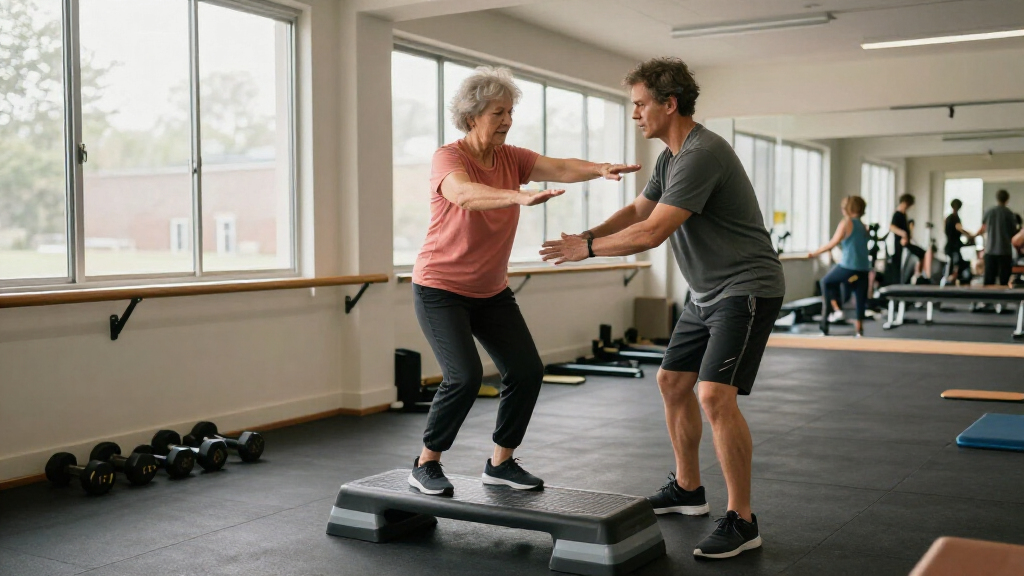
Fit&Well has published a trainer’s account of three coordination exercises she includes in classes and personal-training sessions with older adults, offering standing and seated versions to suit different mobility levels. The report presents the movements as ways to practise coordinating the arms and legs; it does not show that the exercises prevent falls or extend lifespan.
The trainer says she incorporates coordination work into chair-based yoga classes and personal training. Her stated aim is to practise the connection between attention and movement, including moving limbs in different directions. The report links that practice to everyday tasks such as moving around other people or handling more than one task at home, but those benefits are described by the trainer rather than measured outcomes from her clients.
The first movement is a knee raise paired with the opposite arm. From standing, a person raises one knee while bringing the other arm forward at shoulder height, then returns to the starting position and switches sides. The report suggests five to six repetitions per side. Its seated option is a controlled march, with the opposite arm raised in front or overhead.
The second exercise pairs a side step-out with an opposite-arm reach. A person steps to one side and reaches the opposite arm forward, returning to the middle before changing sides. The trainer describes a side lunge as optional, not required, and recommends five to six repetitions per side. Seated participants can move one leg out to the side while opening the opposite arm. The third drill uses a light ball toss and catch: the person throws it underhand against a wall and catches it, with one or both hands. It can be made easier by standing on both feet or doing it seated; the report suggests five to 10 throws.
Coordination Practice for Daily Movement
The report focuses on a type of exercise that may be less familiar than strength training, while emphasizing that coordination can be practised at different mobility levels. Alternating movements ask participants to control more than one body part at a time. The ball drill also involves following an object and responding to where it lands. These are descriptions of the tasks involved, not proof that doing them will produce a particular health outcome.
For readers choosing an activity, the practical point is that the listed movements have lower-impact or seated alternatives, and the standing versions can be adjusted. That flexibility may make the drills easier to adapt to a class or home routine. The report does not provide clinical screening guidance, establish a suitable difficulty for every person, or compare the exercises with other forms of training.
lightweight soft exercise ball for seniors hand toss and catch
As an affiliate, we earn on qualifying purchases.
As an affiliate, we earn on qualifying purchases.
What the Report Says About Evidence
The trainer’s case for coordination work includes a reference to a 2019 review of balance and coordination exercises in older adults. As summarized in the Fit&Well report, the review found improvements in cognitive processes such as spatial awareness, as well as postural control and stability in distracting environments. The source material does not identify the review’s authors, journal, study count, or the size and duration of the reported effects, so those details cannot be assessed here.
The report also notes that strength training is commonly associated with ageing well, while arguing it is not the only kind of exercise to include. Its practical recommendations are the instructor’s selections for her sessions, rather than a formal exercise prescription. The cited review concerns balance and coordination exercises broadly; it is not presented as a trial of these three specific movements.
“I always incorporate coordination training into my chair-based yoga classes and personal training sessions with older adults”
— The trainer, as quoted in the Fit&Well report
sturdy chair with arms for seated senior exercises
As an affiliate, we earn on qualifying purchases.
As an affiliate, we earn on qualifying purchases.
Limits of the Exercise Evidence
The source does not give a publication date for the Fit&Well article or enough bibliographic information to identify and independently evaluate the 2019 review. It also does not report measured results from the trainer’s own clients or say how often, for how long, or at what intensity participants should do these drills.
It remains unclear whether these specific exercises improve balance or daily function when used on their own, and whether they are appropriate for every older adult. The report does not claim that they prevent falls, treat a medical condition, or increase lifespan. People with health concerns or difficulty balancing may need guidance from a qualified health or exercise professional before trying standing versions.
senior balance and coordination exercise equipment
As an affiliate, we earn on qualifying purchases.
As an affiliate, we earn on qualifying purchases.
How Readers Can Use the Suggestions
The report offers the movements as adaptable examples, not as a fixed programme. Readers can review the seated alternatives and suggested repetition ranges in the source and ask an appropriately qualified instructor to help adjust the movements to their abilities. The source does not announce a follow-up study, a new class programme, or another scheduled development; further evidence would be needed to establish the effects of these exact exercises.
Key Questions
Which coordination exercises does the report describe?
It lists a knee raise with the opposite arm, a side step with an opposite-arm reach, and an underhand ball throw and catch.
Can the exercises be done seated?
Yes. The report describes seated versions of all three: a controlled march with an opposite-arm raise, a side leg movement paired with an arm opening, and a ball-catching drill performed while seated.
What research does the article cite?
The Fit&Well report refers to a 2019 review of balance and coordination exercises in older adults. It says the review found improvements in spatial awareness, postural control, and stability in distracting environments, but the provided source material does not include the full citation or study details.
Do these exercises prevent falls or extend lifespan?
The report does not establish either outcome for these three exercises. It presents them as coordination practice and summarizes broader findings about balance and coordination training.
Source: rss
Halloween Picks
halloween
As an affiliate, we earn on qualifying purchases.